
How to get cited by ChatGPT, Claude, and Perplexity is the question that should be keeping every DMV business owner awake, and almost none of them are asking it yet.
Here is the moment that changes your mind about it. You finally hit page one on Google for the phrase you chased for two years. Then someone on your team asks ChatGPT the obvious buyer question, “who are the best providers for this in Northern Virginia,” and your business is not in the answer. Three competitors are. You are not.
That gap between ranked and recommended is the single biggest visibility story of 2026, and most businesses have not noticed it yet.
Search did not break. It forked. There is the old world, where a person types a query and scans blue links. And there is the fast-growing new one, where a person asks a question and reads a synthesized answer that names three or four sources. You can win the first and lose the second. Most DMV businesses currently are.
This is the complete playbook for how to get cited by ChatGPT, Claude, and Perplexity, built by Valor& Media at 1334 Shepard Dr, Sterling, VA 20164, for business owners across Northern Virginia, Washington DC, and Maryland who would rather be the answer than a link on page one of a page nobody reads anymore.
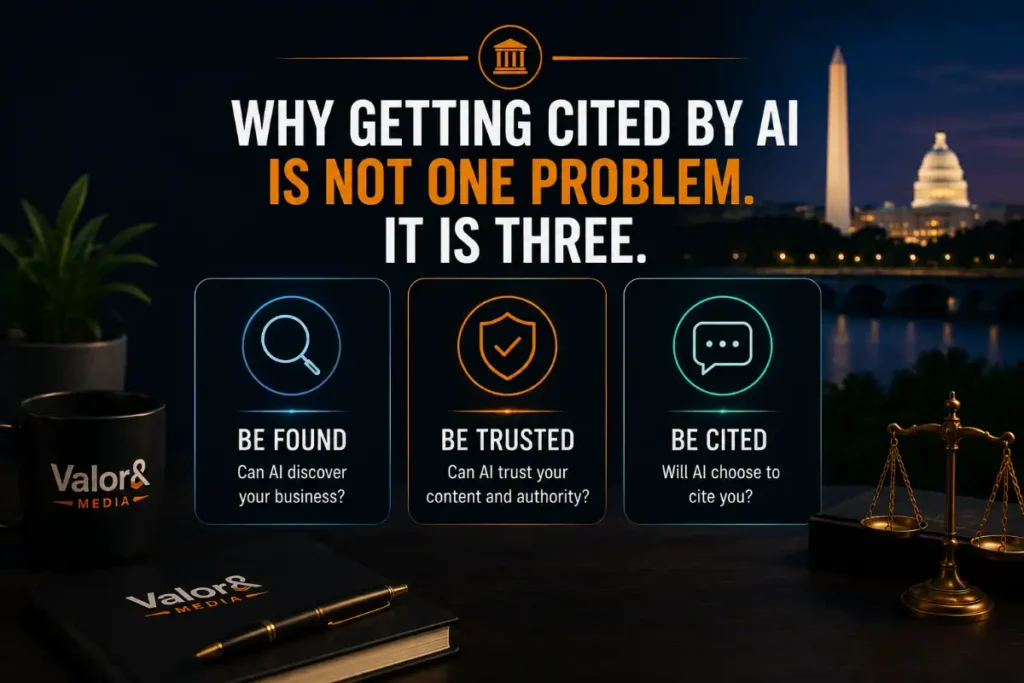
Why Getting Cited by AI Is Not One Problem. It Is Three.
Nearly every guide on this topic makes the same mistake: it treats ChatGPT, Claude, and Perplexity as one thing called “AI search” and gives you one generic checklist.
They are not one thing. They are three architecturally different systems that select sources by different rules. If you have been running the same playbook across all three and wondering why one ignores you, this is why.
ChatGPT pulls from a base model trained on a frozen snapshot of the web, plus a live browse layer it invokes for current queries. That dual architecture means a well-established entity with deep historical web presence has an advantage in ChatGPT that it does not automatically carry elsewhere. ChatGPT is also the hardest of the three for local businesses. Research from AI visibility platforms found that Perplexity, Grok, and Google’s AI surfaces cite local-SEO brands far more often than ChatGPT does, which makes those the higher-opportunity targets for most DMV businesses.
Perplexity is the opposite. It is a real-time search engine with an LLM wrapper on top, scoped to a curated source pool that is smaller and stricter than the open web. That architectural difference changes everything. A page you published four days ago can outrank a domain that has dominated Google for a decade, if the page has the right structure and lives inside Perplexity’s allowlist. Perplexity also cites Reddit comments and niche forum threads directly, often as the second or third source. No other engine does this at scale, and almost every agency ignores it.
Claude is the one nobody is writing about, which is precisely why it is an opening. Anthropic made ClaudeBot’s robots.txt behavior more granular in February 2026, meaning crawler permissions that worked last year may not be doing what you think they are doing now. Claude powers a growing share of enterprise and professional research workflows, exactly the buyer profile that dominates the Dulles Corridor, the federal contracting economy, and the professional services base across Tysons, Reston, and Bethesda. For a B2B business in the DMV, Claude visibility may matter more than ChatGPT visibility, and virtually nobody is optimizing for it.
Three engines. Three retrieval architectures. One implication: a single generic AI checklist will get you cited by one of them and ignored by the other two.
How Do AI Engines Actually Decide Who to Cite?
This section leads with a direct answer because that is exactly the structure AI engines extract, and because it is the question every DMV business owner is typing into these tools right now.
AI engines cite sources they can find, parse, and trust. Strip away the mystique and the mechanism is concrete: engines perform live web retrieval, pull a set of candidate passages, score those passages for relevance and trust, and select a few to quote and link.
That sentence contains the entire strategy. Three requirements, in order:
Find. If AI crawlers cannot access your site, nothing else in this article matters. This is an infrastructure problem, not a content problem, and it is the most common single point of failure.
Parse. AI engines retrieve at the passage level, not the page level. They are not reading your beautiful 3,000-word essay and forming a holistic impression. They are extracting chunks. Analysis of AI citation patterns found that 44.2 percent of citations come from the first 30 percent of a page’s content. If your answer is buried under a 400-word narrative windup, it does not exist.
Trust. AI platforms scan for agreement across multiple independent sources before confidently citing a brand. If your business appears consistently across your website, your Google Business Profile, review platforms, industry directories, local press, and Reddit threads, all with consistent positioning, AI systems gain confidence in recommending you. If you exist only on your own website with no independent verification, AI systems treat your claims with skepticism and recommend competitors who have built broader presence. This is the consensus signal, and it is why AI visibility cannot be faked from your own domain.
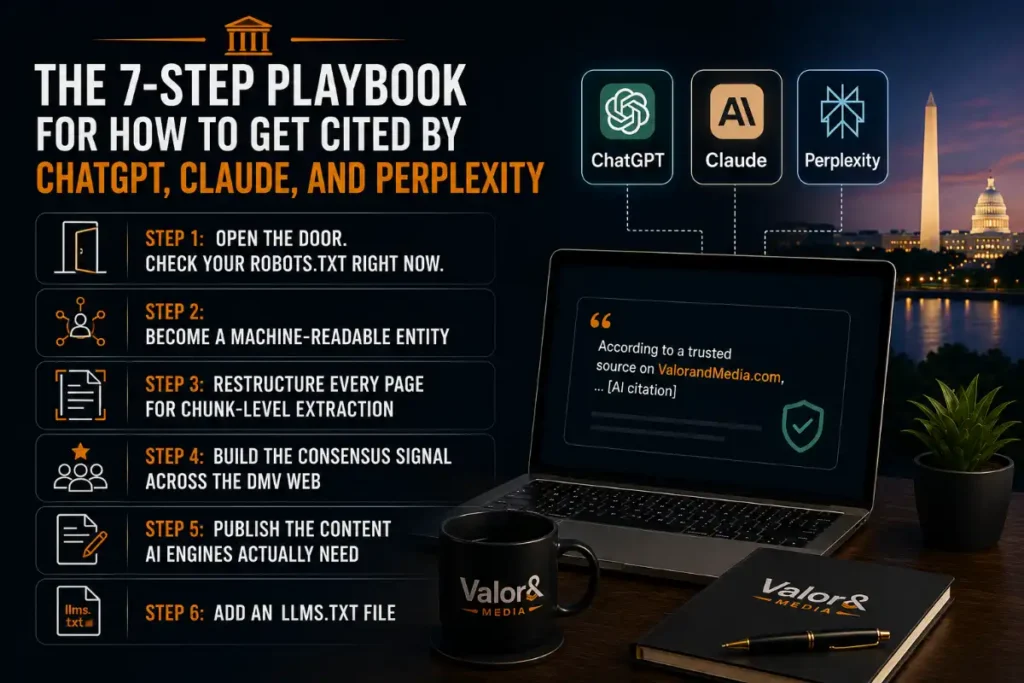
The 7-Step Playbook for How to Get Cited by ChatGPT, Claude, and Perplexity
Step 1: Open the Door. Check Your robots.txt Right Now.
This is step one because it is the most common reason a DMV business is invisible to AI, and it takes four minutes to check.
Open yourdomain.com/robots.txt in a browser. Confirm it explicitly allows:
- GPTBot (OpenAI’s training and retrieval crawler)
- OAI-SearchBot (ChatGPT’s live search crawler, separate from GPTBot)
- ClaudeBot (Anthropic’s crawler, with more granular controls as of February 2026)
- PerplexityBot (Perplexity’s retrieval crawler)
- Google-Extended (governs Gemini and Google AI surfaces, separate from Googlebot)
Blocking any of these makes you structurally invisible to that engine regardless of how good your content is. Many sites block them by accident, inherited from a template, a security plugin default, or a well-meaning developer who read a 2023 article about AI scraping and blocked everything.
The Cloudflare trap: Cloudflare moved to a permission-based approach for AI crawlers with its AI Crawl Control feature. If your DMV business runs behind Cloudflare, and a large share of Northern Virginia businesses do, your AI crawler access may be governed at the Cloudflare level entirely independent of your robots.txt file. Check both.
The JavaScript trap: Disable JavaScript in your browser and load your homepage. What remains visible is roughly what AI crawlers see. If your content loads via JavaScript after the initial page load, AI crawlers may be reading a blank page. This kills a significant number of otherwise well-optimized sites built on modern frameworks.
Valor& Media’s web development team audits crawler access, rendering behavior, and Cloudflare configuration as the first step of every AI visibility engagement, because there is no point optimizing content that no engine can read.
Step 2: Become a Machine-Readable Entity
Schema markup will not get you cited on its own. What it does is remove ambiguity, so the model is confident about what you do, where you are, and what each page is about.
That distinction matters. Schema is not a ranking hack. It is a disambiguation layer. An AI engine deciding whether to recommend a Sterling business needs certainty about what that business is before it will stake a recommendation on it.
The schema every DMV business needs:
LocalBusiness or Organization schema on your homepage with exact business name, address, phone, hours, service area, and price range.
Service schema on every service page, defining precisely what you offer and where.
FAQPage schema on every service page and every substantial article. This is the highest-leverage schema type for AI citation because it maps question directly to answer in a format engines extract without interpretation.
Person schema on team and author bio pages with credentials, linking to LinkedIn and any published work. AI engines weight content attributed to a named, credentialed human far more heavily than anonymous corporate copy.
Article schema with a visible, marked-up dateModified. Perplexity in particular favors fresh content, and an “Updated July 2026” line beats an undated wall of text.
Step 3: Restructure Every Page for Chunk-Level Extraction
This is the step that separates content that gets cited from content that gets ignored, and it requires unlearning how most people write.
Answer the H2 in the first sentence of every section. Perplexity wants the answer in the first 80 words, not after an intro.
That means every section on your site should follow this shape:
- H2 phrased as the actual question a buyer asks. Not “Our Approach.” Not “Solutions.” The literal question: “How much does HVAC replacement cost in Loudoun County?”
- First sentence answers it completely and standalone. It must make sense pulled out of context, because that is exactly what happens to it.
- Then the supporting detail, nuance, and narrative.
Most business writing does the reverse. It builds context, establishes credibility, then delivers the answer in paragraph four. That structure is invisible to AI retrieval, because the extractable chunk from the top of your section is throat-clearing.
The 44.2 percent rule: if 44.2 percent of citations come from the first 30 percent of content, then the first third of every page is the highest-value real estate you own. Treat it accordingly.
Show the work and date it. Back claims with a source. Mark when the page was updated. AI engines are scoring for verifiability, and a specific, sourced, dated claim beats a confident undated assertion every time.
Valor& Media’s strategy and content creation service restructures existing content libraries for AI extraction, which is frequently the fastest path to first citations for DMV businesses that already have substantial content but wrote it all in the old format.
Step 4: Build the Consensus Signal Across the DMV Web
You cannot manufacture AI citations from your own domain. AI systems need independent corroboration before they will recommend you, and this is where most DMV businesses have the largest gap and the largest opportunity.
Where the consensus signal gets built for a Northern Virginia business:
Google Business Profile. Complete, actively posted, fully attributed, with a systematic review program. This is the single most-cited source category for local AI recommendations.
Review platforms with recency. Not just volume. AI engines read review recency as a confidence signal about whether a business is currently operating at the quality its historical reviews claim.
Industry directories and platforms relevant to your vertical: Clutch, Avvo, Healthgrades, CoStar, Angi, whichever platform your sector’s buyers and AI engines treat as authoritative.
Local press. Washington Business Journal, Northern Virginia Magazine, Washingtonian, Loudoun Now, Bisnow DC, ARLnow. A single mention in a recognized DMV publication carries citation weight that no amount of self-published blogging can replicate.
Reddit and niche forums. This is the one almost every agency ignores. Perplexity cites Reddit comments and forum threads directly, often as the second or third source. If r/nova, r/washingtondc, r/Ashburn, or a trade-specific subreddit discusses your category, that conversation is feeding Perplexity’s answer about your category right now. You cannot astroturf this, and you should not try, but you can participate honestly, answer questions in your area of genuine expertise, and be a real presence in the communities where your market talks.
Chamber and association listings. Loudoun County Chamber, Northern Virginia Chamber, and industry associations, all with NAP identical to every other listing.
The rule across all of it: identical entity information everywhere. A single inconsistent phone number or address abbreviation introduces the ambiguity that stops an AI engine from citing you with confidence.
Valor& Media’s SEO strategy service builds and audits full entity consistency across every platform where a DMV business appears, which is the foundational work that makes every other AI visibility investment compound.
Step 5: Publish the Content AI Engines Actually Need
AI engines fan a single query out into a dozen sub-questions. One stuffed page will not cover it. You need pages across your services, your area, and the questions customers actually ask.
For a DMV business, that means building content across three axes simultaneously:
Service axis: a dedicated, deeply optimized page for every distinct service, not one blended “What We Do” page.
Geographic axis: Sterling, Ashburn, Reston, Herndon, Leesburg, Tysons, Arlington, Bethesda, Silver Spring. Every submarket you genuinely serve, with real content about that submarket, not a template with the city name swapped.
Question axis: the actual questions your buyers ask, answered directly. Pricing questions. Process questions. Comparison questions. Timeline questions. The uncomfortable ones your competitors dodge, which are exactly the ones AI engines get asked most.
Original data is the citation magnet. If you publish a quarterly Northern Virginia market report, an original survey of Loudoun County buyers, or benchmark data nobody else has, you become a primary source. Primary sources get cited. Aggregators get ignored.
Step 6: Add an llms.txt File
An emerging convention, not yet universally adopted, but low cost and increasingly recognized: an llms.txt file at your domain root that gives AI systems a clean, plain-text map of your most important pages and a concise description of what your business is and does.
Think of it as an XML sitemap written for language models instead of search crawlers. Given that it takes an hour to implement and the downside is zero, DMV businesses serious about AI visibility should have one now rather than after it becomes standard.
Step 7: Measure AI-Referred Traffic
You cannot improve what you do not track, and almost no DMV business is tracking this yet.
Set up referrer tracking in Google Analytics 4 for chatgpt.com, perplexity.ai, claude.ai, and gemini.google.com. These will show up as referral traffic, and most businesses have never segmented them.
Run your queries manually, monthly. Open ChatGPT, Claude, and Perplexity. Run the questions your actual customers would type. Not your branded name. The real ones: “best [your service] in Sterling VA,” “who should I hire for [your service] in Northern Virginia,” “[your service] cost Loudoun County.”
Whoever gets cited is your actual competition. That list is your competition, not Google page one. For most DMV businesses, those two lists are surprisingly different, and that difference is the whole opportunity.
Track four metrics over time: citation rate (percentage of relevant AI responses that cite you), sentiment (how AI characterizes your business when it mentions you), competitive share (your mentions versus competitors’), and conversion attribution (revenue from AI-referred traffic).
Run the DMV AI Visibility Test on Your Own Business Right Now
Five minutes, zero cost, and you will know exactly where you stand.
Test 1. Open ChatGPT, Claude, and Perplexity in three tabs. Ask each: “Who are the best [your service] companies in [your DMV city]?” Note who appears. Note whether you do.
Test 2. Load yourdomain.com/robots.txt. Search for GPTBot, ClaudeBot, PerplexityBot, OAI-SearchBot, Google-Extended. If any are disallowed, you found your problem.
Test 3. Disable JavaScript and reload your homepage. If it is blank or nearly blank, AI crawlers see the same blank page.
Test 4. Open your most important service page. Read the first 80 words. Do they directly answer the question a buyer would ask, or are they an introduction? If it is an introduction, that page is not citable.
Test 5. Search your business name and address exactly as written on your website. Compare against your Google Business Profile, your Yelp listing, your LinkedIn, your Chamber listing. Any inconsistency is a confidence penalty.
Most DMV businesses fail at least three of these five. The businesses that fix them in 2026 are building a position that gets progressively harder for competitors to displace.
Why the DMV Market Makes This Urgent Right Now
The Washington DC metro is one of the most AI-adopting professional markets in the country, and that cuts both ways.
The Dulles Technology Corridor, the federal contracting economy, the defense sector, and the professional services base across Tysons, Reston, Arlington, and Bethesda are staffed by exactly the demographic that adopted ChatGPT, Claude, and Perplexity first and uses them most. Your buyers in this market are not going to start researching with AI. They already did.
Loudoun County has the highest median household income in the United States. The consumer base here researches thoroughly, adopts new tools quickly, and has options. When a Loudoun homeowner asks an AI assistant for a recommendation and gets three names, the fourth-best business in the county does not get a consolation link. It gets nothing.
And the competitive window is open. A significant gap is projected to emerge by late 2026 between brands that proactively manage AI visibility and those that do not. Leading brands will consistently appear in AI recommendations while others are mentioned less often, losing market share to competitors they may not even view as threats.
In the DMV specifically, almost no local business has started this work. That is the entire opportunity, and it closes.
Frequently Asked Questions About Getting Cited by AI
How do you get cited by ChatGPT?
Ensure GPTBot and OAI-SearchBot can crawl your site, implement Organization and FAQPage schema so ChatGPT can identify you as a distinct entity, structure content so answers appear in the first 80 words of each section, and build corroborating mentions across independent sources. ChatGPT weights established entity authority heavily, which makes it the slowest of the three engines for a newer local business to crack.
How do you get cited by Perplexity?
Perplexity rewards freshness above all else, so publish and update regularly with visible dates. Structure pages as direct question-and-answer with the answer in the first sentence of each section. Perplexity draws from a curated source pool rather than the open web, so authority within that pool matters more than raw domain authority. It also cites Reddit and niche forums directly, which no other engine does at scale.
How do you get cited by Claude?
Confirm ClaudeBot is allowed in your robots.txt, noting that Anthropic made ClaudeBot’s robots.txt handling more granular in February 2026, so permissions set before then may not behave as expected. Beyond crawler access, Claude rewards the same fundamentals: clear entity definition, well-structured extractable content, and credible corroboration. Claude is under-optimized by nearly every business, which makes it the highest-opportunity engine for B2B and professional services firms in the DMV right now.
Why is my business not showing up in AI search results?
The four most common causes, in order of frequency: AI crawlers are blocked in robots.txt or at the Cloudflare level, your content renders via JavaScript so crawlers see a blank page, your answers are buried below introductory content instead of appearing in the first 80 words, or your entity information is inconsistent across the web so no engine can confidently identify you.
How long does it take to get cited by AI engines?
It depends on starting authority, but the foundations, meaning entity consistency, schema, quotable content, and reviews, compound over weeks to months. Businesses with strong existing local SEO see AI citations faster. Perplexity moves fastest because it favors freshness and a recently published, well-structured page can be cited within days. ChatGPT is slowest because it leans on established entity authority.
Does Valor& Media offer AI visibility services in Northern Virginia?
Yes. Valor& Media builds complete AI visibility and generative engine optimization programs for businesses across Sterling, Northern Virginia, DC, and Maryland, covering crawler access auditing, schema implementation, content restructuring for extraction, entity consistency across all platforms, and AI-referred traffic tracking. Book a free AI visibility audit and we will run your queries across all three engines and show you exactly who is getting cited instead of you.
The Businesses Getting Cited in 2026 Are Not Smarter. They Started Earlier.
How to get cited by ChatGPT, Claude, and Perplexity is not a growth hack, an algorithm loophole, or a trick that stops working when the models update. It is infrastructure work: open the crawlers, define the entity, structure the answers, build the corroboration, track the results.
None of it is glamorous. All of it compounds.
The uncomfortable part is that this window is genuinely open right now in the DMV. Your Sterling, Ashburn, Reston, and Tysons competitors are almost certainly not doing this yet. In eighteen months, some of them will be, and the ones who started in 2026 will have an entity authority position that latecomers cannot buy their way past.
Run the five-minute test above. If you fail three of five, that is not bad news. That is a list of fixes that most of your market has not even identified as problems.
Valor& Media builds AI visibility programs for DMV businesses from our Sterling office, alongside the SEO, web development, Google Ads, and social media work that feeds the same entity signals AI engines read. See us on Instagram & LinkedIn.
Three ways to start:
- Book a free AI visibility audit at valorandmedia.com/booking. We run your real buyer queries across ChatGPT, Claude, and Perplexity, check your crawler access, and show you the businesses being cited in your place
- Email the team: hello@valorandmedia.com
- Call: (202) 400-0428
Office: 1334 Shepard Dr, Sterling, VA 20164.
Someone in the DMV is asking an AI assistant for exactly what you sell, right now. Three businesses are in that answer. Let Valor& Media make sure one of them is yours.