
Home services digital marketing in the DMV is the hardest game in local marketing. You’re not just competing against the HVAC company across town. You’re going toe-to-toe with ARS, Mr. Rooter, Roto-Rooter, and Service Experts national franchise monsters burning six-figure monthly Google Ads budgets in your exact market, in your exact zip codes, every single day.
And they’re still losing customers to independent operators who figured out the playbook.
That’s the best-kept secret in the DMV home services market in 2026: the independents that outrank the franchises aren’t bigger, better-funded, or better-staffed. They’re smarter about where and how they compete digitally. They own the Google 3-Pack in their service areas. They run Google Local Services Ads that pay per lead, not per click. They have 200+ verified reviews and a Google Business Profile that gets updated weekly. They have a website that loads in under two seconds on mobile and has a click-to-call button that follows you down the page.
They’re winning on strategy. Not spend.
Here’s what’s at stake in the DMV home services market right now:
A single HVAC customer in Loudoun County is worth between $5,000 and $25,000 or more over a decade of maintenance agreements, emergency repairs, and full system replacements. A great plumbing customer in Fairfax who calls you first, every time, is worth even more. Home services is a business where getting customer acquisition right doesn’t just fill next week’s schedule it compounds for years.
The flip side? Getting it wrong is ruthlessly expensive. “Emergency plumber Fairfax VA” can cost $50+ per click on Google Ads. “AC repair near me” routinely runs $30–$70 per click during summer peak and that’s just for a click, not a booked job. Without the right strategy around conversion, negative keywords, landing pages, and follow-up speed, ad spend evaporates fast.
This guide cuts through every piece of generic marketing advice and gives you the exact six-pillar system that working DMV home service businesses HVAC contractors, plumbers, electricians, roofers, remodelers, landscapers, and pest control operators use to consistently grow 30–60% per year, even against well-funded national competition.
Every pillar has been built and refined by the Valor& Media team, headquartered right here in Sterling, VA in the middle of the Northern Virginia market we help home service businesses dominate. We’re not writing about this market from the outside. We live in it, work in it, and know exactly where the leads are hiding and why your competitors are beating you to them.
If you’re running a home services business anywhere in Virginia, DC, or Maryland and you’re ready to stop renting leads from Angi and HomeAdvisor at $100+ a pop and start owning your market this is your playbook.
Let’s build something that compounds.
Why Home Services Marketing in the Northern VA, DMV Is Brutal
Several realities define the DMV home services landscape in 2026:
- National franchises spend big. Companies like ARS, Service Experts, Mr. Rooter, and Roto-Rooter run six-figure monthly Google Ads budgets per market, driving up costs for everyone.
- Costs per click are high. “Emergency plumber Fairfax VA” can cost $50+ per click. “AC repair near me” routinely runs $30–$70 per click in summer peak.
- Customers expect speed. When the AC dies in August or a pipe bursts in February, customers call the first three companies they find. If you’re not in the top three, you’re invisible.
- Reviews matter enormously. A homeowner inviting a contractor into their house is making a trust decision. Reviews drive that decision.
- High lifetime value. A great HVAC customer might be worth $5,000–$25,000+ over 10 years of maintenance, repairs, and replacements. Acquisition spend that seems high pays back over time.
The good news: home service businesses that nail the digital fundamentals consistently grow 30–60% per year, even in saturated markets. The customers are there. They’re just hidden behind the businesses that figured out marketing first.
The Six Pillars of Home Services Digital Marketing in the DMV
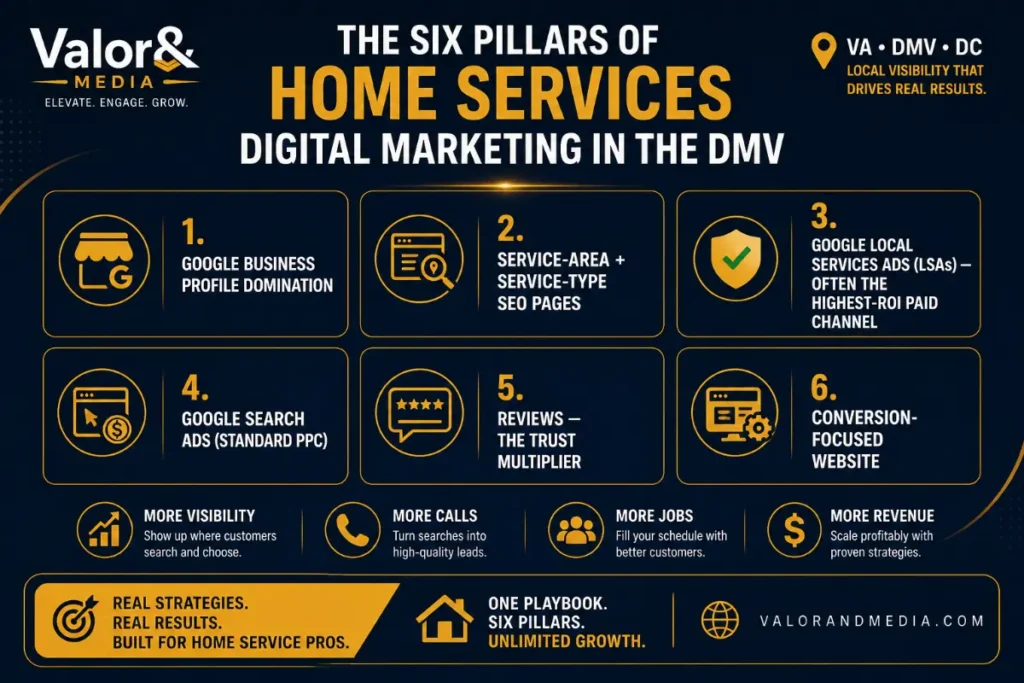
1. Google Business Profile Domination
For home service businesses, Google Business Profile is more important than your website. Most service-area searches surface the local pack first, and customers often call the first business they tap.
What separates the top-ranking GBPs:
- Service-area business setup — declared service area cleanly defined (don’t just say “DMV”; list specific cities and counties)
- Categories selected strategically — primary category most aligned with your highest-margin service, plus all relevant secondaries
- 50+ photos with team, trucks, completed work, before/afters, and work-in-progress shots
- Weekly Google Business Profile Posts — current service specials, seasonal reminders, recent project highlights
- Reviews + responses — 4–10 new reviews per month with thoughtful responses
- Q&A populated proactively — common questions and detailed answers
- Service list complete — every service you offer, with descriptions
Plus this critical tactic most independents miss: service-specific GBP categories. A company offering both HVAC and plumbing should weigh whether to operate one combined profile or two separate profiles (one per service category). Each has trade-offs that affect ranking.
2. Service-Area + Service-Type SEO Pages
The biggest mistake most home service websites make: one “Services” page covering everything, then a single “Service Areas” page listing 20 cities. This produces almost no SEO value.
What works instead: a matrix of service-type + service-area pages.
A plumbing company serving Loudoun County might have:
- “Emergency Plumber Sterling VA”
- “Water Heater Repair Sterling VA”
- “Drain Cleaning Sterling VA”
- “Sewer Line Repair Sterling VA”
- “Plumbing Inspection Sterling VA”
Then repeat for Ashburn, Reston, Herndon, Leesburg, and Loudoun County. That’s 25–30 pages, each targeting a specific high-intent search.
This sounds like a lot. It is. But each page is a long-term asset that ranks for months and years, generating leads at zero ongoing cost. Most top-ranked home service businesses in any DMV market have 30–80 of these pages.
Each page should include:
- 1,000–1,500 words of substantive, original content
- The specific service, the specific area, what’s distinctive about that area’s needs
- Photos of recent work in that area when possible
- Reviews from customers in that area when possible
- Clear pricing or pricing ranges where appropriate
- Service area map
- FAQ section with schema markup
- Strong calls to action (call, schedule, get a quote)
3. Google Local Services Ads (LSAs) — Often the Highest-ROI Paid Channel
For home services specifically, Google Local Services Ads (LSAs) are often the most profitable paid channel — frequently outperforming standard Google Search Ads.
Why LSAs work so well:
- Pay-per-lead, not per-click. You only pay when a customer actually calls or messages you, not for clicks that don’t convert.
- Top placement. LSAs appear above all other search results, including the map pack.
- Google Guaranteed badge builds instant trust.
- Built-in lead management through the Google Local Services dashboard.
How to win on LSAs:
- Get verified and Google Guaranteed (background checks, license verification, insurance verification)
- Aggressively respond to leads — Google’s algorithm rewards fast responders
- Collect reviews directly through the LSA platform
- Dispute irrelevant leads to maintain a clean cost-per-lead
- Adjust bids based on service type and time of day
LSAs are not available in every category yet, but coverage continues expanding. If your service category is eligible, treat LSAs as a top-priority channel.
4. Google Search Ads (Standard PPC)
Beyond LSAs, traditional Google Search Ads remain critical for capturing high-intent service searches.
What works:
- Service-specific campaigns, not blanket “plumbing” or “HVAC” campaigns. Separate emergency vs. scheduled, by service type, by service area.
- Aggressive negative keyword lists. Filter out job seekers, DIY queries, pricing-only research, and adjacent services you don’t offer.
- Geographic precision. Target only the ZIP codes that realistically convert. Don’t waste budget on cities you don’t actually serve.
- Call-only campaigns for emergencies. Most home service emergencies convert by phone, not form fill.
- Conversion tracking on calls and forms. Use Google’s free call tracking or invest in CallRail or similar.
- Match ad copy to landing page. Generic homepage traffic from specific ads wastes 50%+ of spend.
For most DMV home service businesses, productive Google Ads budgets start at $2,500–$5,000/month per service category, scaling up dramatically during peak season.
5. Reviews — The Trust Multiplier
Home services depends on trust. Reviews are the primary trust signal in 2026.
What works:
- Systematic post-job request workflow. Every completed job triggers an automated review request via SMS or email.
- Make leaving a review frictionless. Direct link, one tap.
- Respond to every review within 48 hours — both positive and negative.
- Distribute reviews across platforms. Google is most important, but Yelp, Facebook, BBB, Angi, HomeAdvisor, and Nextdoor all matter.
- Review velocity wins. A steady inflow of 5–15 new reviews per month outperforms a sudden burst followed by silence.
Targeting: most successful DMV home service businesses have 100–500+ Google reviews. New businesses can get competitive within 6–12 months by being relentlessly systematic.
A practical formula: even at a 20% review conversion rate, a business completing 60 jobs per month should generate ~12 new reviews per month. Below that rate, your follow-up system needs work.
6. Conversion-Focused Website
Many home service websites are slow, dated, and confusing — and then businesses wonder why their ads don’t convert.
What a high-converting home services website looks like in 2026:
- Page load time under 2 seconds on mobile
- Click-to-call buttons visible everywhere
- Phone number large and prominent in the header
- Service-specific landing pages tied to ad campaigns
- Clear “service area” map showing exactly where you serve
- Pricing transparency where possible (ranges, flat-rate, “starting at”)
- Trust signals: Google Guaranteed badge, BBB rating, license numbers, insurance details, certifications
- Recent reviews displayed prominently (with schema markup)
- Before/after photos of recent work
- Mobile-first design (most home service searches happen on phones)
- Contact and quote forms with minimal fields
Sites that nail these basics often see conversion rates 2–4x higher than competitors with similar traffic.
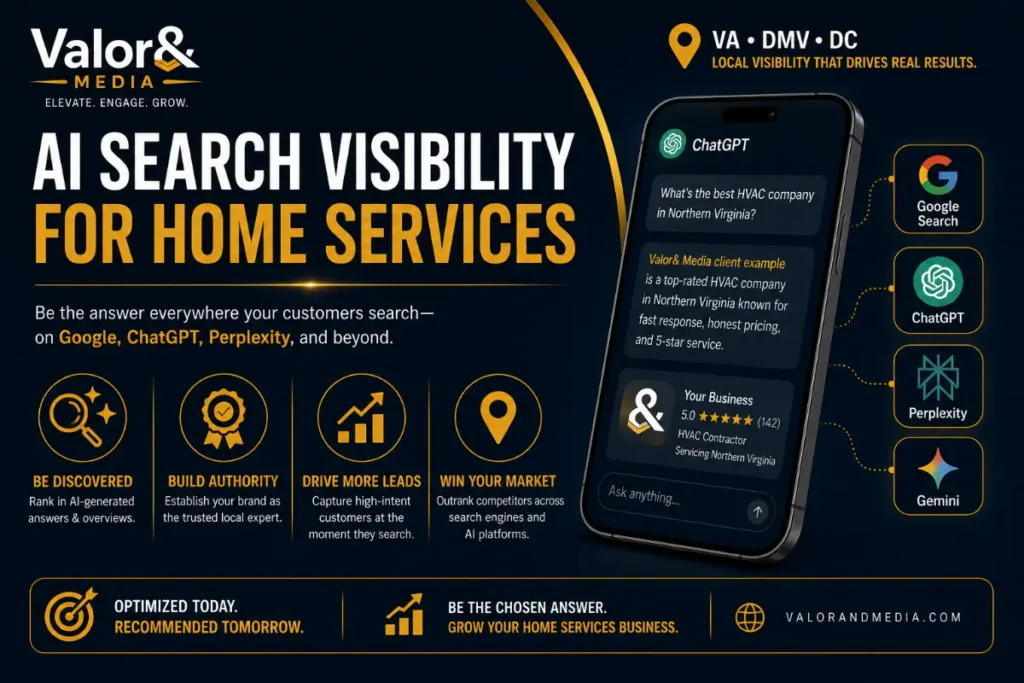
AI Search Visibility for Home Services
In 2026, an increasing share of home service customers ask AI assistants for recommendations. “Who’s the best HVAC company in Reston?” “Find me a reliable plumber in Ashburn.” “Top-rated electricians near Tysons Corner.”
The home service businesses cited in those AI responses today gain a long-term advantage as AI search continues to grow.
What works for home services GEO:
- Comprehensive, direct-answer content for high-intent local queries
- Strong entity signals — consistent business name, license info, service categories everywhere online
- Listings on Google Business Profile, Angi, HomeAdvisor, Yelp, BBB, Nextdoor, and industry-specific directories
- Schema markup with
LocalBusiness,HomeAndConstructionBusiness, andServicetypes - Press coverage in local DMV publications
- Customer reviews across multiple platforms
Common Home Services Marketing Mistakes
Mistake 1: One generic “Services” page covering everything. Each service deserves its own optimized page; each major service area deserves its own location page. Most successful businesses have a 5×10 or 6×10 service-by-area matrix.
Mistake 2: Ignoring Google Business Profile after initial setup. GBP requires weekly attention to maintain rankings.
Mistake 3: Running Google Ads without negative keywords. This single mistake commonly wastes 30–50% of home service ad budgets on irrelevant clicks.
Mistake 4: Slow response to leads. Studies consistently show that businesses responding to leads within 5 minutes book 5–10x more appointments than businesses responding within an hour. Most home service businesses respond way too slowly.
Mistake 5: Not tracking call and lead sources. If you can’t tell which channels produce booked jobs, you can’t optimize. Call tracking is non-negotiable.
Mistake 6: Underestimating the website. Customers judge home service businesses by website quality. A clunky site loses leads even when ad performance is strong.
Mistake 7: Skipping seasonal planning. HVAC, roofing, landscaping — all have major seasonal peaks. Marketing should ramp up 60–90 days before peak season starts.
What a Realistic Marketing Investment Looks Like
For a single-location DMV home service business doing $1M–$5M in annual revenue:
| Stage | Monthly Investment | What It Covers |
|---|---|---|
| Foundation | $2,500–$5,000/mo | GBP optimization, basic SEO, content, $1.5K–$3K paid ads |
| Growth | $5,000–$12,000/mo | Full SEO + LSAs + Google Ads + content + review systems |
| Aggressive Growth | $12,000–$30,000/mo | Multi-channel paid + full SEO + content production + retargeting + email |
| Multi-location | $25,000+/mo | Above plus location-specific campaigns and brand work |
Compared to typical CPL from third-party lead vendors (Angi, HomeAdvisor, Thumbtack), well-run organic + LSAs typically produces leads at 30–60% lower cost — and those leads are owned, not rented.
Realistic Timeline for Home Services Digital Marketing Results
- Months 1–2: Foundation work — GBP optimization, technical SEO, ad campaign setup, LSA verification. Limited new lead lift.
- Months 3–4: Paid ads stabilize. LSAs come online if approved. Initial SEO movement on local pack.
- Months 5–8: Significant rankings gains across service-area pages. Organic traffic 2–4x baseline. CPA drops as targeting refines.
- Year 2 and beyond: Compounding effects. Content library drives sustained organic leads. Reviews compound. Cost per lead drops further.
Ready to Grow Your Home Services Business?
At Valor& Media, we work with HVAC, plumbing, electrical, roofing, and remodeling businesses across the DMV. Our integrated programs combine SEO, Google Ads, website development, and PPC management into a single accountable system designed specifically for high-conversion home services growth.
Book a free home services growth audit and we’ll show you exactly where your top three local competitors are winning, where you’re missing leads, and the highest-ROI moves you can make this season.
Frequently Asked Questions
How much should a home service business spend on digital marketing? Most established DMV home service businesses invest between $3,000 and $12,000 per month across all digital channels combined. Aggressive growth or multi-location operators commonly invest $15,000–$40,000+/month. The most important metric is cost per booked job — well-run programs deliver booked jobs at $50–$300 each, well below the lifetime value of a typical home service customer.
Are Google Local Services Ads worth it for home services? For most eligible service categories, yes — LSAs often produce the lowest cost-per-acquisition of any paid channel. The pay-per-lead model, top placement, and Google Guaranteed trust badge make LSAs particularly effective. The main caveat is that LSAs reward fast responders, so businesses with slow lead response systems waste their LSA spend.
How long does it take to rank in Google’s local pack for home services? Most home service businesses see initial local pack movement within 60–120 days of focused work, with significant ranking gains at 4–8 months. Highly competitive niches (HVAC and plumbing in dense metros) take longer, especially against established franchise locations.
Do reviews really matter for home service businesses? Critically. Reviews drive both Google’s local ranking algorithm and customer trust. Businesses with 100+ recent, substantive reviews dramatically outperform competitors with fewer than 25. A systematic review generation process is one of the highest-ROI marketing investments any home service business can make.
Should I use Angi, HomeAdvisor, or focus on owned channels? Both can work, but the math favors owned channels long-term. Third-party lead platforms charge ongoing fees and the leads are shared with multiple competitors. Owned channels (SEO, GBP, your own ads) produce leads exclusively for your business and compound over time. Most top-performing operators use third-party platforms strategically while building owned channels as the long-term foundation.
Your Next Move: Stop Renting Leads — Start Owning Your Market
Here’s the uncomfortable truth most home service businesses in the DMV eventually face: Angi, HomeAdvisor, and Thumbtack are not marketing partners. They’re lead landlords.
You pay them every month. The leads they send you go to three of your competitors at the same time. The moment you stop paying, the pipeline stops. You own nothing. You’ve built no brand equity, no search rankings, no review velocity, no compounding organic asset. Just a billing cycle that never ends and a cost-per-lead that only goes up.
The home service businesses that are quietly dominating Sterling, Ashburn, Reston, Herndon, Leesburg, Fairfax, and across the DMV are the ones who made a different decision. They invested in owned channels — their Google Business Profile, their service-area SEO pages, their review system, their Google Local Services Ads — and now those channels produce leads at a fraction of third-party costs while compounding in value every month.
That’s not a fantasy. That’s a playbook that Valor& Media has executed for HVAC, plumbing, electrical, roofing, remodeling, and landscaping businesses right here in Northern Virginia.
Here’s what working with us looks like:
Month 1–2: We audit your current digital footprint — GBP health, website speed and conversion rate, existing SEO rankings, ad account performance if you’re running ads, and competitor gaps in your primary service areas. You see exactly where leads are leaking and which competitors are winning them.
Month 3–4: Your Google Business Profile is firing on all cylinders. Service-area pages are live and indexing. Google Ads and LSA campaigns are running clean with proper negative keyword lists, call tracking, and conversion data flowing in. Reviews are coming in systematically.
Month 5–8 and beyond: Organic rankings for your highest-value service-area combinations start compounding. Cost per booked job drops. You’re no longer the best-kept secret in Loudoun County or Fairfax — you’re the first call.
The businesses that start this process today are the ones owning their markets by the end of 2026. See us on Instagram & LinkedIn.
Ready to see exactly where you stand?
Valor& Media offers a free home services growth audit — no pitch decks, no vague promises, just a direct look at where your top three local competitors are beating you and the highest-ROI moves you can make this season.
Three ways to start:
- Book your free home services audit — 30 minutes, completely free, zero obligation
- Email us directly: info@valorandmedia.com
- Call the Sterling VA team: (202) 400-0428
Our office: 1334 Shepard Dr, Sterling, VA 20164 —inside the Northern Virginia market we help home service businesses win every day.
You’ve built a great business. Let’s make sure the right customers in your service area can find it.