Google Hotel Ads is the single most important paid distribution channel available to independent hotels in 2026. Not because it is the newest platform. Not because it is the cheapest. Because it is where travelers with a credit card in hand are actively comparing room rates right now, and your direct booking rate is either showing up in that comparison or it is not.
If it is not showing up, you are handing that booking to Booking.com or Expedia at a commission rate of 15 to 25 percent per night. On a $250 room in the DMV market, that is $37 to $62 per night, per room, per booking, paid to a platform that owns the guest relationship, the email address, and the repeat booking opportunity.
Every booking an independent hotel takes through an OTA costs 15 to 25 percent of the room rate in commission. Every booking taken direct costs nothing. The math is not complicated, but the execution is.
Google Hotel Ads changes the execution. This guide gives independent hotels in Virginia, the DMV, and beyond everything they need to go live, choose the right bidding model, optimize for performance, and capture the AI search visibility that is reshaping how travelers find and book hotels in 2026.
Built by the Valor& Media team, headquartered at 1334 Shepard Dr, Sterling, VA 20164, and serving travel and hospitality clients across the Northern Virginia.
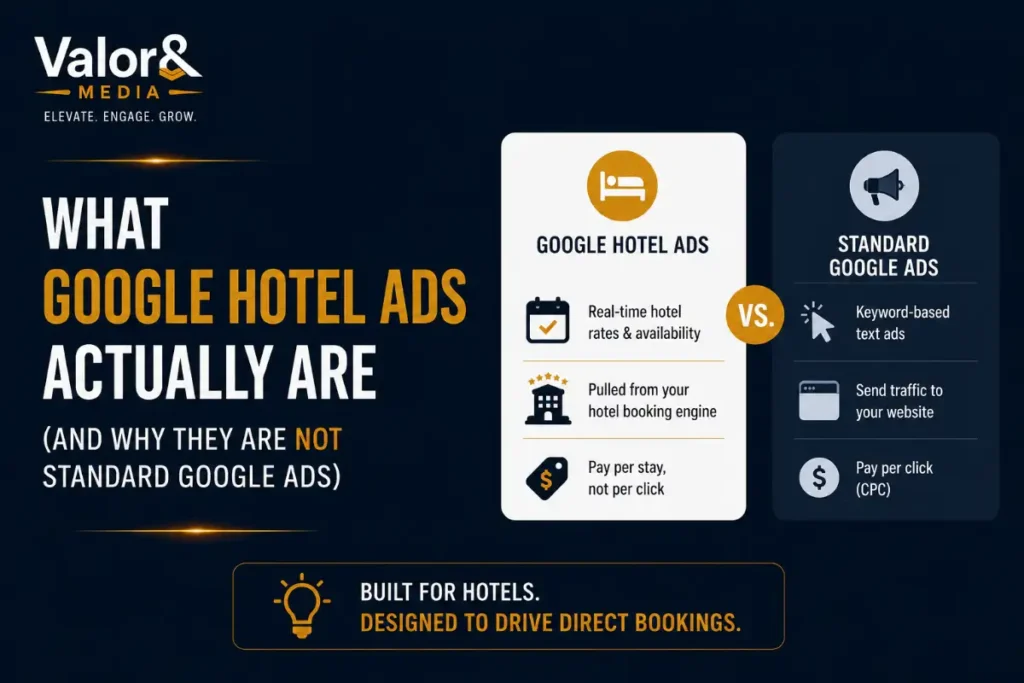
What Google Hotel Ads Actually Are (And Why They Are Not Standard Google Ads)
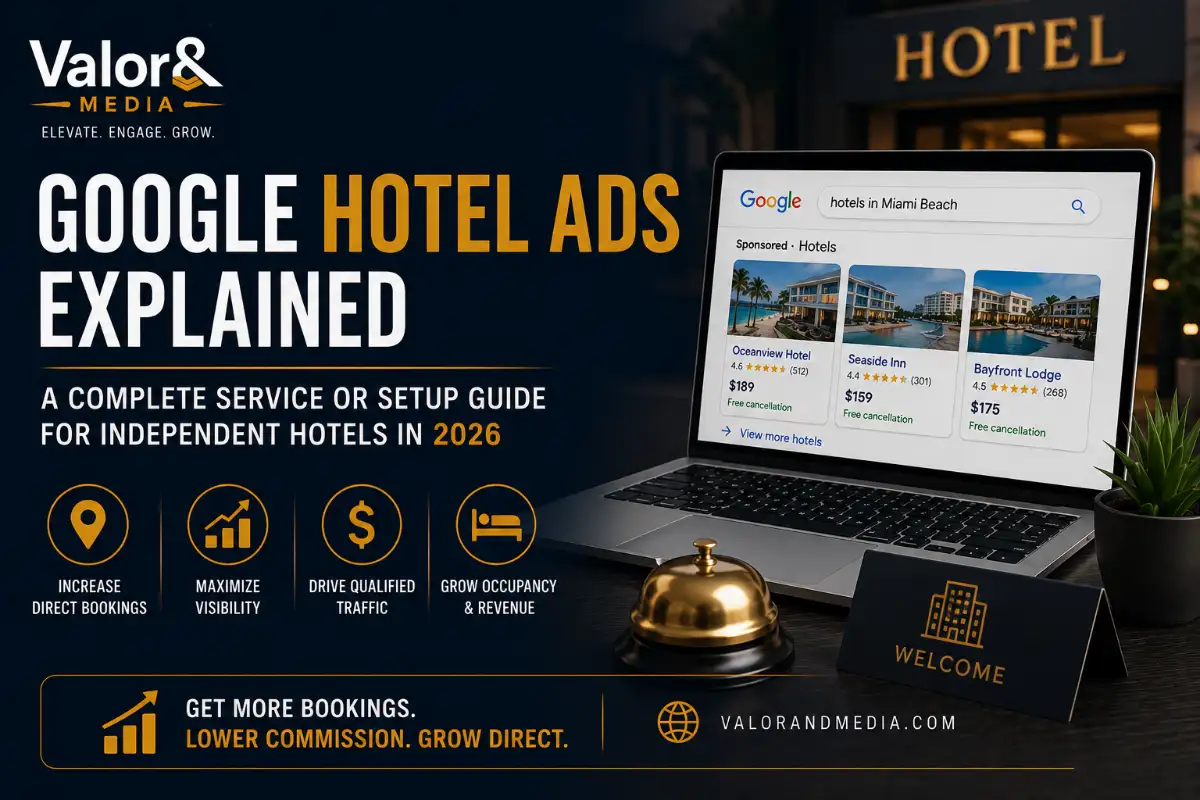
Google Hotel Ads are a metasearch product that displays live rates in Google Search results, Google Maps, and Google Travel. Hotels compete directly with OTAs for price visibility in the Google Hotel Booking module.
That last sentence is the key distinction most independent hotel operators miss. Standard Google Search Ads target keyword queries like “hotels in Reston VA” and send traffic to a landing page. Google Hotel Ads display your actual live room rates, real-time availability, and a direct booking link directly inside Google Search, Google Maps, and Google Travel, right alongside the Booking.com and Expedia listings for your property.
When a traveler searches for a hotel in Dulles, Ashburn, or Arlington, Google surfaces a hotel booking module at the top of the results page. That module shows your property with current pricing from multiple sources including OTAs and, if you are live on Google Hotel Ads, your own direct booking rate. The traveler compares rates without ever leaving Google and clicks the cheapest or most compelling option.
The platform levels the playing field. Independent hotels and smaller properties appear alongside major OTA listings in Google Search, Google Maps and Google Travel, competing for the same high-intent traffic without being buried behind commission-heavy intermediaries.
Google Hotel Ads now captures over 30 percent of all hotel metasearch traffic globally, making it the single largest performance marketing channel for independent hotels.
That market share number is the reason independent hotels in the DMV market cannot afford to treat Google Hotel Ads as optional in 2026.
The 2026 Alert Every Virginia Hotel Operator Needs to Read First
Before the setup guide, one critical 2026 development that zero competitor guides have addressed yet.
Google AI Mode is now surfacing direct hotel booking links inside AI-generated travel answers. When a traveler asks Google AI Overview “best boutique hotels near Dulles Airport” or ChatGPT “where to stay in Loudoun County Virginia,” the AI response is now showing hotel booking links directly inside the answer.
Smaller independent hotels without Google Hotel Ads integration or strong hotel official website AI search signals may actually become more dependent on OTAs as AI Mode scales, not less.
Translation: running Google Hotel Ads is no longer just about appearing in the price comparison module. It is now the technical prerequisite for appearing in AI-generated travel recommendations with a direct booking link. Hotels that are not integrated with Google Hotel Ads in 2026 will be systematically excluded from AI travel search as that channel grows, regardless of how good their property is.
This is the most important reason to get your Google Hotel Ads setup complete before the end of this quarter. The window to establish AI search visibility before it becomes a competitive moat is closing fast.
Step-by-Step Google Hotel Ads Setup for Independent Hotels
Step 1: Build and Fully Optimize Your Google Business Profile
The vast majority of hotels already have a Google Business Profile listing, and it is a prerequisite for running Google Hotel Ads campaigns. If you do not have one, this is your starting point.
For independent hotels in the DMV market, your Google Business Profile is not just an administrative requirement. It is the anchor of your entire digital visibility strategy. Every element of your GBP affects both your Google Hotel Ads performance and your organic Google Maps ranking.
A fully optimized hotel GBP for the Virginia market includes:
Complete property information that triggers trust:
- Legal hotel name matching your booking engine exactly
- Full physical address with suite number if applicable
- Primary phone number with a direct line to your reservations team
- Hotel website URL pointing to your booking engine, not just your homepage
- Accurate check-in and check-out times, parking details, and amenities list
- Hotel category selected correctly (Hotel, Boutique Hotel, Motel, Inn, etc.)
Visual assets that convert impressions to clicks:
- Minimum 25 high-resolution photos across categories: exterior, lobby, room types, dining, pool, fitness, local area
- Video walkthrough of your property (30 to 90 seconds performs best)
- Updated photos showing seasonal amenities (pool in summer, fireplace in winter)
- Team photos that humanize the property and build trust
Review strategy that feeds the algorithm:
- Systematic post-stay review request via SMS and email
- Response to every review within 24 hours including negative reviews
- Reviews mentioning specific amenities (“great pool,” “easy Dulles access,” “walkable to wineries”) that become ranking signals
Q and A section pre-populated with the questions DMV travelers actually ask:
- “Is there shuttle service to Dulles Airport?”
- “What is your pet policy?”
- “Do you offer government rate for federal employees?”
- “Is there free parking on site?”
For Northern Virginia hotels specifically, proximity signals to Dulles International Airport, the Dulles Tech Corridor, DC monuments, and Shenandoah Valley day trips are the geographic anchors that your GBP description, posts, and Q and A should reinforce consistently.
Valor& Media’s web and digital marketing team builds complete GBP optimization strategies for travel and hospitality clients across the DMV, including photo sourcing, review generation systems, and local SEO integration.
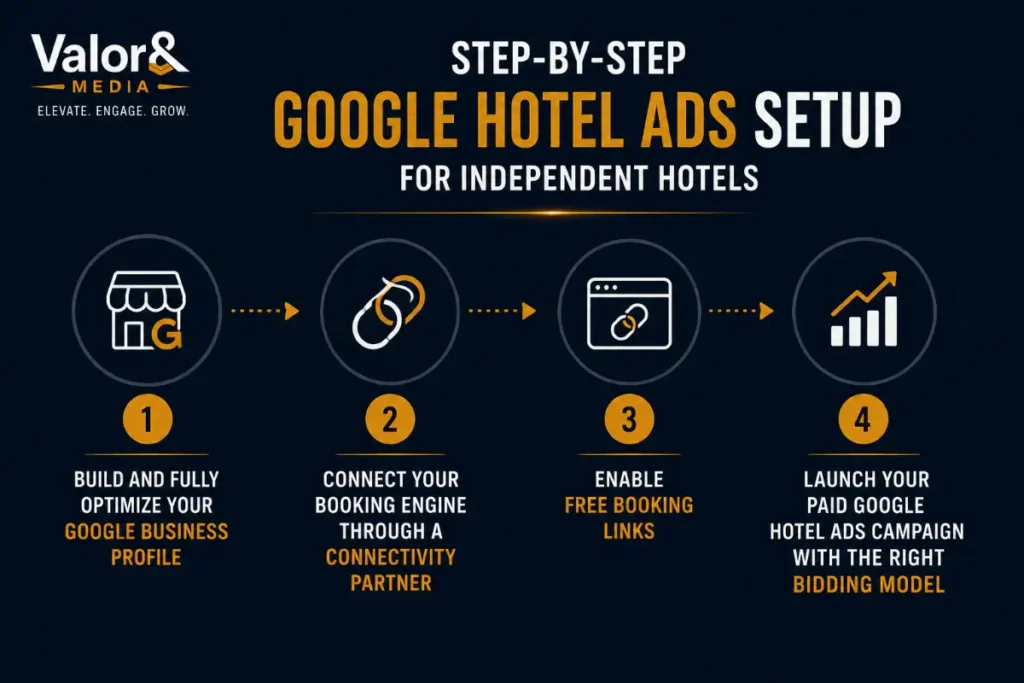
Step 2: Connect Your Booking Engine Through a Connectivity Partner
Strong integration between your booking engine, channel manager, and connectivity partner keeps real-time rates and availability accurate.
This is the technical step most independent hotel operators underestimate. Google Hotel Ads requires a live, continuous data feed of your room rates and availability to display correctly inside the Google Hotel booking module. That feed must come through either a Google-certified connectivity partner or directly from your property management system.
The most widely used connectivity partners for independent hotels:
- SiteMinder
- Cloudbeds
- Opera Cloud (Oracle)
- SynXis (Sabre)
- Mews PMS
- Cloudbeds
- RoomRaccoon
- Little Hotelier
If your property already uses a channel manager or PMS, check whether it is Google-certified. Most modern systems are. If you are still managing rates manually through an OTA extranet, connecting a proper channel manager is the foundational infrastructure investment that makes Google Hotel Ads possible and every other distribution channel more efficient.
The integration connects your live inventory to Google so that when a traveler searches for your hotel on a specific date, they see your actual available room types and your actual direct booking rates, updated in real time. If this feed is broken or delayed, your rates will not display correctly and you will lose clicks to OTAs who maintain accurate feeds.
Step 3: Enable Free Booking Links
Before spending a single dollar on paid Google Hotel Ads, every independent hotel should activate Google’s free booking links. You do not need a large budget. It is worth exploring the ROI of sponsoring your direct booking channel, especially given OTAs’ often high commission fees.
Free booking links appear in the organic section of the Google Hotels price comparison module, below paid placements. While click volume is lower, typically 15 to 25 percent of paid Google Hotel Ads traffic, the conversion rate is comparable because users who scroll past paid results tend to be more deliberate searchers.
Activating free booking links requires the same GBP setup and connectivity partner integration as paid Google Hotel Ads. Once connected, your direct rate appears in the free section automatically at zero cost per click. This is commission-free revenue with no advertising spend and every independent hotel in Virginia and the DMV should have it active immediately if they do not already.
Step 4: Launch Your Paid Google Hotel Ads Campaign With the Right Bidding Model
When setting up Google Hotel Ads campaigns, you need to select a bidding strategy. The strategy determines how much you pay for each click or user action.
Choosing the wrong bidding model for your property size and cash flow is one of the most common mistakes independent hotels make when launching Google Hotel Ads. Here is the full breakdown of all four models:
Commission Per Conversion (Pay Per Booking) You pay Google only when a booking is completed through your direct booking link. The commission rate is negotiated through your connectivity partner but typically runs 10 to 12 percent per booking.
Best for: Independent hotels with limited cash flow, seasonal properties, and operators who want guaranteed ROI before paying. Zero risk on clicks that do not convert.
Commission Per Stay (Pay After Checkout) You pay after the guest has actually completed their stay, not at the time of booking. This model completely eliminates the risk of paying for cancelled reservations that never generate revenue.
Best for: Properties in markets with higher cancellation rates, budget-conscious operators, and hotels with strong shoulder-season demand. With the pay-per-stay model, you only pay for completed stays, not clicks, cancellations or no-shows, which strengthens cash flow because payments land in your account immediately instead of waiting weeks for OTA payouts.
Cost Per Click (CPC) You set a maximum bid per click and pay every time a traveler clicks your direct booking link in the Google Hotel Ads module, regardless of whether they complete a booking. CPC bidding gives you maximum control over position and visibility.
Best for: Hotels with optimized booking engines and high conversion rates who want to compete aggressively for top placement during peak travel periods. Requires careful monitoring and negative targeting to avoid wasted spend.
Enhanced CPC (eCPC) Google automatically adjusts your manual CPC bid upward or downward based on predicted conversion probability. You set the maximum, Google optimizes within that ceiling.
Best for: Hotels with 90 or more days of performance data who want algorithmic optimization without fully automated bidding. Combines control with machine learning efficiency.
For most independent hotels, starting with a commission-based strategy provides a lower-risk entry point. Commission Per Conversion or Commission Per Stay is the recommended starting model for Virginia independent hotels that are new to Google Hotel Ads, because it eliminates downside risk while the campaign builds performance history.
Rate Parity: The Optimization Factor That Determines Your Click-Through Rate
Rate parity is not a compliance suggestion for Google Hotel Ads. It is the single most direct driver of click-through rate performance in the Google Hotels booking module.
Google Hotel Ads displays your rate alongside OTAs. If Booking.com shows a lower price, even by one dollar, a significant portion of users will click the OTA listing instead. Maintaining strict rate parity is essential for performance. Properties using automated rate matching that ensures their direct rate is always at or below OTA rates on Google see 25 to 40 percent higher click-through rates on their listings.
For Northern Virginia and DMV hotels, where average nightly rates for quality independent properties run $180 to $350 depending on proximity to DC and the Tech Corridor, rate parity management is essential. A $5 rate discrepancy on a $280 room costs far more in lost direct bookings than the $5 itself.
Your channel manager should be configured to automatically match or beat your OTA rates on your direct booking feed to Google. If you are manually setting rates across channels, rate leakage is almost guaranteed and your Google Hotel Ads performance will reflect it.
Bidding Optimization: What Separates Average and High-Performing Campaigns
The gap between a baseline Google Hotel Ads setup and an optimized one is substantial, with well-managed campaigns seeing 40 to 60 percent better ROAS than default configurations.
Here is what that optimization looks like in practice for independent hotels in the Virginia and DMV market:
Device bidding adjustments: Mobile travelers searching “hotels near Dulles tonight” are often booking for the same evening. Desktop searches from someone planning a trip two weeks out have lower urgency but higher average stay value. Adjust your Google Hotel Ads bids up for mobile in the 24 to 48 hour booking window and down for desktop searches with longer lead times.
Date and length-of-stay targeting: Government event calendars in Washington DC drive predictable demand spikes throughout the year. Presidential inaugurations, Congressional recesses ending, federal agency conferences, and major DC events all create booking surges. Structure your bidding calendar around these demand spikes to capture high-intent travelers before OTAs outbid you during peak periods.
Geographic audience adjustments: Travelers searching from within 50 miles of your property are more likely to be planning a local event stay, weekend getaway, or staycation. Travelers from New York, Philadelphia, Atlanta, and other major markets searching for DMV hotels represent higher average stay length and higher spending per visit. Bid differently for these audiences.
Room type separation: Do not run a single Google Hotel Ads campaign for your entire property. Separate campaigns by room type allow you to bid more aggressively on high-margin suites and specialty rooms while keeping standard rooms on lower-cost commission models.
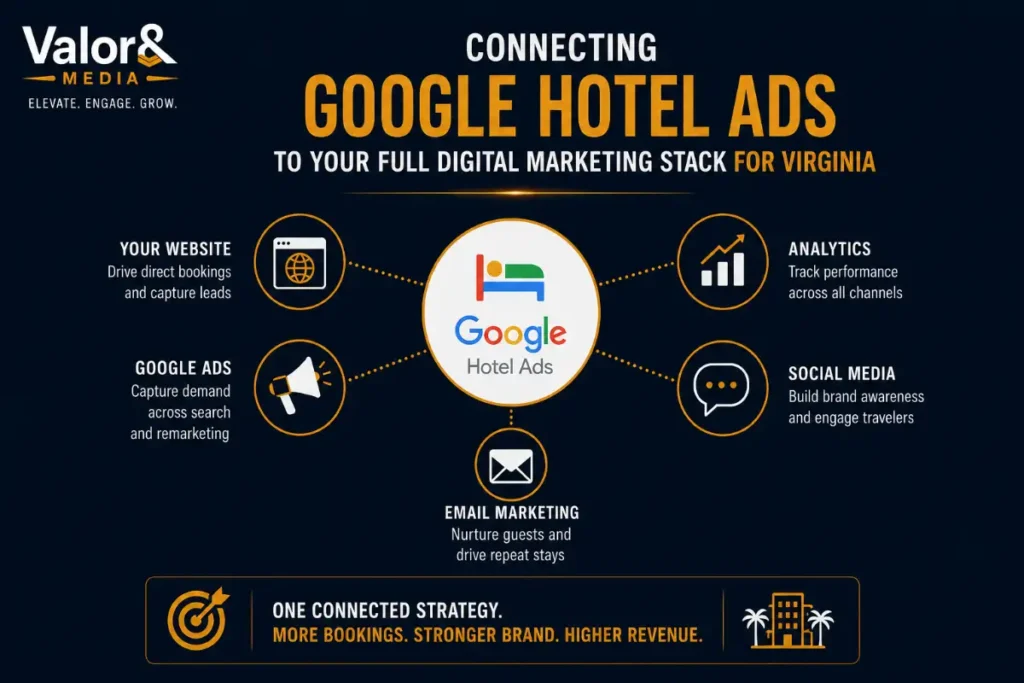
Connecting Google Hotel Ads to Your Full Digital Marketing Stack
Google Hotel Ads performs best as one channel in an integrated hospitality marketing system, not as a standalone campaign running in isolation.
Here is how the full stack works together for independent hotels in the DMV:
Your hotel website as the conversion engine: Every Google Hotel Ads click that reaches your website must convert. A slow, dated, or non-mobile-optimized booking experience destroys the ROI of every click you pay for. Valor and Media’s web design and development team builds hotel websites that load under two seconds on mobile, display your live rates with a seamless booking flow, and are structured for both conversion and search engine ranking.
SEO as the organic foundation: SEO strategy for independent hotels in Virginia builds organic search rankings for niche travel queries (“pet-friendly hotels Loudoun County,” “boutique hotel near Dulles Airport,” “Virginia wine country hotel weekend”) that compound in value every month and reduce your dependence on paid channels over time.
Google Ads for branded and competitor protection: Google Ads management for hotels runs in parallel with Google Hotel Ads to protect your branded search terms, capture competitor hotel searches, and target high-intent local queries that the hotel booking module does not cover. PPC campaign management ensures your total Google presence is coordinated across both standard search and hotel metasearch.
Social media for retargeting and loyalty: Travelers who clicked your Google Hotel Ads listing but did not complete a booking are your highest-value retargeting audience. Facebook marketing and Instagram marketing retargeting campaigns keep your property top-of-mind for these warm prospects across the 7 to 21 day decision cycle that most leisure travelers follow.
YouTube for destination marketing: YouTube marketing for independent hotels in Virginia builds organic and paid visibility for destination search queries. A 60-second property tour video ranking for “hotels in Loudoun County Virginia” or “where to stay near Shenandoah National Park” captures decision-stage travelers who will then book through your Google Hotel Ads direct link.
AI Search Visibility for Independent Hotels in 2026
Every independent hotel in the DMV market needs to understand what is happening at the intersection of Google Hotel Ads and AI search in 2026.
Google’s AI Mode is now embedding direct hotel booking links inside AI-generated travel answers. ChatGPT’s partnership with SiteMinder and other channel managers is beginning to surface direct booking rates inside ChatGPT travel recommendations. Perplexity is synthesizing hotel recommendations from structured data sources, prioritizing properties with complete Google Business Profiles, verified reviews, and strong schema markup.
What AI-visible hotel marketing requires in 2026:
Entity completeness across all platforms: Your hotel name, address, phone, website, and amenity descriptions must be identical across your Google Business Profile, your website, TripAdvisor, Yelp, Expedia partner profile, Booking.com listing, and any regional Virginia tourism directory. AI engines cross-reference these signals to assess property legitimacy before featuring a hotel in generated recommendations.
Schema markup on your hotel website: LocalBusiness, Hotel, and LodgingBusiness schema on your website tells AI engines your property type, location, amenities, price range, and booking link structure. Without it, AI tools cannot reliably feature your property in generated travel answers.
Review velocity that signals active management: AI search tools increasingly weight review recency and volume when ranking hotel recommendations. A property with 15 reviews from 2022 loses AI recommendation placement to a competitor with 40 reviews from 2026 regardless of star rating.
Content built around specific traveler intent queries: A page on your website answering “What are the best hotels near Dulles International Airport with free parking?” or “Best boutique hotels for a Virginia wine country weekend” creates the structured, AI-extractable content that earns your property a mention in AI travel recommendations.
Valor and Media’s travel and hospitality digital marketing service integrates Google Hotel Ads management with AI visibility strategy, website optimization, and social media marketing into one accountable system for independent hotels across Virginia and the DMV.
Performance Benchmarks: What to Expect from Google Hotel Ads in the DMV Market
Setting realistic performance expectations is part of honest guidance. Here is what well-managed Google Hotel Ads campaigns produce for independent hotels in the Virginia and DC metro market:
ROAS (Return on Ad Spend): Well-optimized campaigns targeting the DMV travel market typically deliver 8x to 15x ROAS, meaning $1 in ad spend generates $8 to $15 in direct booking revenue. Commission-based models make this calculation automatic.
Cost per direct booking: For most independent hotels, an optimized Google Hotel Ads campaign delivers direct bookings at 40 to 60 percent lower acquisition cost than OTAs, with the added benefit of owning the guest relationship and data.
OTA dependency benchmark: If more than 70 percent of your reservations come from OTA websites, it is probably a good idea to reinforce your direct booking channel. A properly optimized Google Hotel Ads program combined with free booking links, SEO, and email marketing should move OTA dependency below 50 percent for most established Virginia independent hotels within 12 months.
Timeline: Most independent hotels see their first direct bookings from Google Hotel Ads within 7 to 14 days of going live if rate parity is maintained and the GBP is fully optimized. Campaign performance improvement is visible at 60 to 90 days as Google’s algorithm accumulates conversion data and optimizes delivery.
Frequently Asked Questions About Google Hotel Ads for Independent Hotels
Do I need a large budget to start Google Hotel Ads?
No. The commission-based bidding models (Per Conversion and Per Stay) require zero upfront budget and charge only when a booking is completed or a stay is finished. This makes Google Hotel Ads accessible to independent hotels of any size in the Virginia and DMV market without cash flow risk during the setup and testing phase.
Can an independent hotel compete with Booking.com and Expedia on Google Hotel Ads?
Yes. Small hotels and motels often see better results because they can personalize landing pages and offers in ways big chains cannot. Rate parity, a well-optimized Google Business Profile, and a fast direct booking experience give independent properties a genuine competitive advantage over OTA listings in the Google Hotel Ads module because the direct booking link carries no commission and hotels can offer perks that OTAs cannot match.
What happens if my rates are higher than OTA rates on Google Hotel Ads?
If Booking.com shows a lower price, even by one dollar, a significant portion of users will click the OTA listing instead. Rate parity is mandatory for effective Google Hotel Ads performance. Use your channel manager’s automated rate matching to ensure your direct rate is always at or below OTA rates displayed in the Google Hotels module.
How does Google Hotel Ads work with AI search in 2026?
Google AI Mode is now surfacing direct hotel booking links inside AI-generated travel responses. Hotels with complete Google Hotel Ads integration, optimized Google Business Profiles, schema markup, and strong review velocity are the properties appearing with direct booking links inside AI travel answers. Hotels without this infrastructure are being replaced by OTA listings in AI-generated results, making the setup even more urgent in 2026.
Does Valor and Media manage Google Hotel Ads for independent hotels in Virginia?
Yes. Valor and Media manages full-service Google Hotel Ads campaigns, Google Ads for hotels, website optimization, and travel industry digital marketing for independent properties across the DMV. Book a free hotel marketing audit to get a complete assessment of your current distribution strategy and the fastest path to reducing your OTA commission exposure.
What is the difference between Google Hotel Ads and free booking links?
Free booking links are organic, zero-cost placements showing your direct rate in the Google Hotels module. They appear below paid Google Hotel Ads placements and generate lower click volume but at zero cost per click. Paid Google Hotel Ads secure premium placement above OTA listings and deliver significantly higher click volume. The optimal strategy uses both simultaneously, with free booking links providing baseline commission-free volume and paid Google Hotel Ads capturing the high-intent travelers who click first.
Stop Paying OTA Commissions You Do Not Have to Pay
Every month your independent hotel runs without active Google Hotel Ads is a month of direct booking revenue transferred to Expedia and Booking.com at commission rates that compound across your entire room inventory.
The math is brutal and simple. A 50-room Virginia boutique hotel averaging 70 percent occupancy at $220 per night, with 60 percent of bookings through OTAs at 20 percent commission, is paying approximately $550,000 per year in OTA commissions on revenue that could be direct. Even capturing 20 percent of that volume through Google Hotel Ads and free booking links represents over $100,000 annually in recovered margin.
Valor& Media manages Google Hotel Ads setup, optimization, and full travel and hospitality digital marketing for independent hotels across Sterling, Ashburn, Reston, Herndon, Leesburg, Tysons, Arlington, and across the Washington DC and Northern Virginia market. See us on Instagram & LinkedIn.
The technical setup is straightforward. The optimization is ongoing. The commission savings start from the first direct booking.
Three ways to start today:
- Book a free hotel marketing audit at valorandmedia.com/booking and get a complete assessment of your Google Hotel Ads readiness and OTA commission exposure in 30 minutes
- Email the team: hello@valorandmedia.com
- Call: (202) 400-0428
Office: 1334 Shepard Dr, Sterling, VA 20164.
Your next direct booking is already searching Google. Make sure your rate is the one they see first.