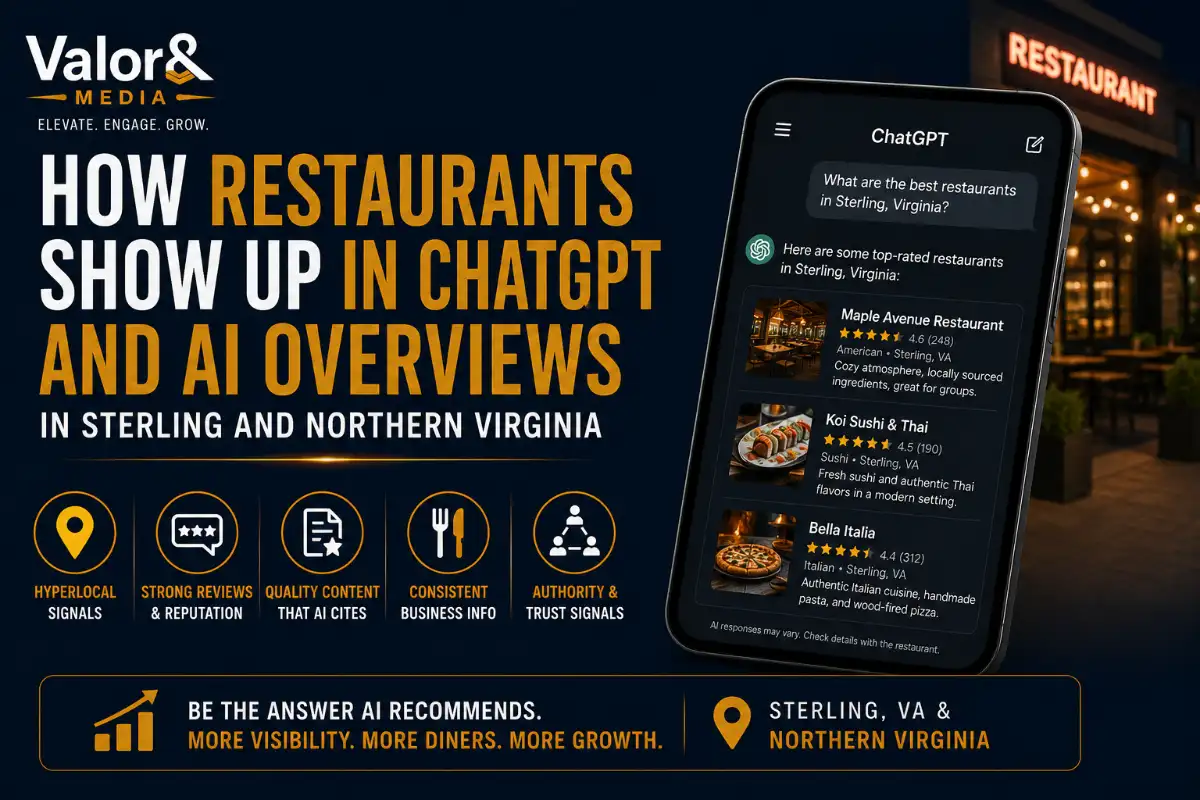
How restaurants show up in ChatGPT and AI Overviews is the most urgent marketing question in the food and beverage industry right now, and most restaurant owners in Sterling, Ashburn, Reston, and across Northern Virginia have no idea the crisis is already happening.
Here is the number that changes everything: 83 percent of restaurant locations are entirely invisible in AI-generated recommendations. When a consumer asks ChatGPT “where can I get a good burger near me tonight,” only 17 percent of restaurants ever appear in the answer, despite 86 percent maintaining an active Google presence.
Read that again. 86 percent of restaurants have a Google presence. Only 17 percent show up when someone asks an AI.
The gap between being on Google and being in AI is not a technical glitch. It is a strategic failure that independent restaurants in Sterling, Loudoun County, Fairfax, and the entire DMV market are about to pay for in reservations, walk-ins, and revenue.
Here is what makes this even more urgent in 2026: 45 percent of consumers now use AI tools like ChatGPT for local business recommendations, up from just 6 percent one year ago. That growth is not slowing. The diners asking Perplexity “best outdoor dining Sterling VA” or telling Google AI Overview “find me an Italian restaurant near Dulles with private dining” are your customers. If your restaurant is not in the answer, a competitor is.
This is the complete 2026 guide to how restaurants show up in ChatGPT and AI Overviews in Northern Virginia. Built by Valor and Media, headquartered at 1334 Shepard Dr, Sterling, VA 20164, for independent restaurants across the DMV that are done being invisible.
Why ChatGPT and AI Overviews Work Completely Differently from Google Search
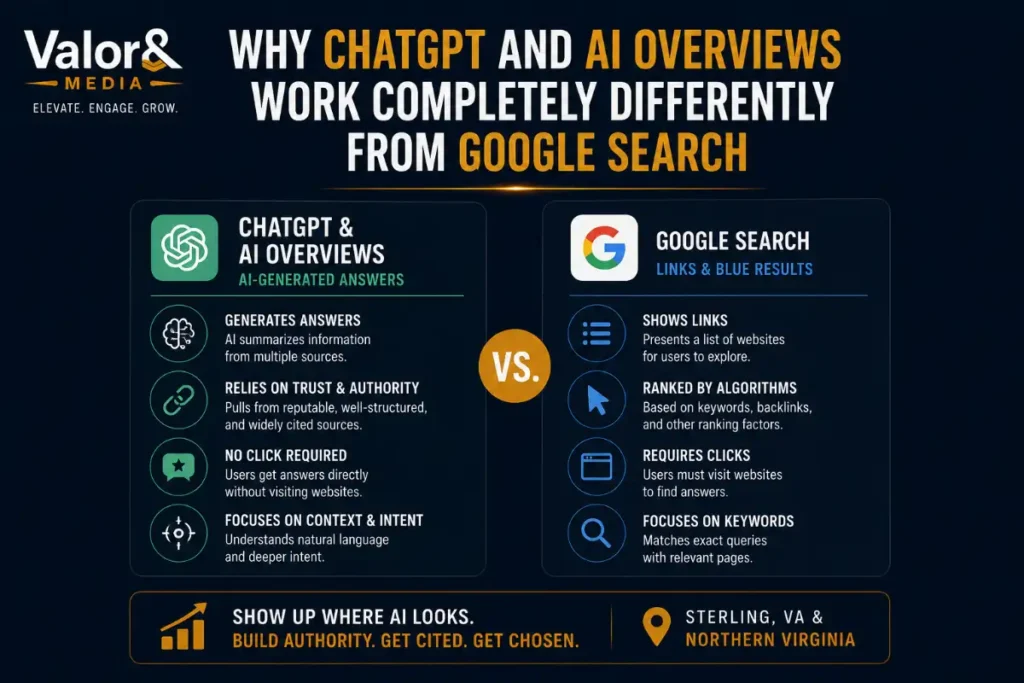
Understanding how restaurants show up in ChatGPT and AI Overviews requires understanding one fundamental difference from traditional search. Google returns a list of options and lets the diner choose. AI assistants return a short curated recommendation and tell the diner what to pick.
That structural difference is the entire problem and opportunity.
When someone types “restaurants near me” into Google, they see 10 to 20 listings in the local pack and organic results. Your restaurant can be listing number seven and still get clicked. When someone asks ChatGPT “best restaurants in Sterling VA for a date night,” they get three to five recommendations. The restaurants outside that list do not exist in that conversation.
Restaurant brands are no longer competing primarily for page-one rankings. They are competing for a small number of recommendation slots inside an AI response.
This is what AI model behavior actually looks like when a potential Sterling diner asks ChatGPT for a restaurant recommendation:
ChatGPT and similar AI assistants do not have restaurant databases like Google Maps or Zomato. Instead, they pull recommendations by analyzing publicly available information from multiple sources simultaneously. When someone types a question into an AI chatbot, where does it go to find the answer? Among the sources it draws from, the most cited at 41.6 percent came from listings on third-party sites such as Yelp, Google Business, and DoorDash. Slightly fewer at 39.8 percent came from first-party websites.
Translation: your restaurant website and your Google Business Profile are the two most important sources AI engines use to decide whether to recommend you. If either is thin, outdated, or inconsistent with your other listings, you are being filtered out before the AI ever generates its response.
On ChatGPT or Gemini, search queries now average 23 words versus 2 to 3 words on a traditional Google search. That means Northern Virginia diners are not typing “restaurant Sterling.” They are asking “what is the best family-friendly restaurant in Sterling VA with a kids menu and outdoor seating that takes reservations on weekends?” Your restaurant’s digital presence must answer that specific, conversational, 23-word question to earn an AI recommendation.
Why AI Search Matters More for Northern Virginia Restaurants Than Almost Anywhere
Before the tactical guide, understand why the DMV restaurant market makes AI search visibility particularly high-stakes.
The Northern Virginia dining market is anchored by some of the most research-driven, digitally sophisticated consumers in America. Loudoun County residents, Dulles Corridor technology professionals, and federal employees across Fairfax, Arlington, and Alexandria are not choosing restaurants impulsively. They are asking Siri, ChatGPT, and Google AI Overview for recommendations during their commute, between meetings, and on their phones before date night.
When a Reston executive asks ChatGPT “best farm-to-table restaurants in Northern Virginia with a good wine list,” or a Sterling couple asks Perplexity “romantic dinner spots near Dulles Airport under $100 per person,” the restaurants appearing in those answers are winning table reservations without spending a dollar on advertising.
Search is now multi-channel. TikTok, Instagram, Maps, and ChatGPT are all part of the same discovery funnel. A restaurant digital strategy must feed them all with structured, visual, and human content or lose discovery in each of them independently.
The stakes compound because of what happens when a restaurant does appear in an AI recommendation. The restaurants that do appear in ChatGPT dominate completely. AI engines surface a small curated shortlist, not a long scroll of options. Being in that shortlist earns outsized reservation share. Being outside it earns nothing.
How ChatGPT, Gemini, and Perplexity Actually Decide Which Restaurants to Recommend
Understanding the mechanism of how restaurants show up in ChatGPT and AI Overviews starts with understanding how AI search engines actually evaluate restaurants. It is not the same logic Google Maps uses. It is not pure star ratings. It is not follower counts or boosted posts.
When AI assistants evaluate restaurants, they build a composite picture of the brand by combining signals from reviews, business listings, public mentions, and website content. Instead of reading one review or one listing, AI systems analyze patterns across many data sources to determine what your restaurant is known for, when it should be recommended, and for whom it is relevant.
Four dimensions consistently shape AI restaurant recommendations:
Dimension 1: Experience Signal Consistency Across Many Reviewers AI models evaluate whether similar experience signals appear across many reviewers, not whether one reviewer left a glowing five-star post. If 40 reviewers mention “amazing outdoor patio in Ashburn,” that is a signal the AI can confidently use when a diner asks for restaurants with outdoor seating. If nobody mentions it, the AI cannot surface your patio as a differentiator regardless of how beautiful it is.
Dimension 2: Entity Consistency Across Platforms Your restaurant name, address, phone number, cuisine type, and hours must be identical across your Google Business Profile, Yelp, TripAdvisor, OpenTable, Facebook, Instagram, and your own website. AI engines cross-reference all of these sources when building their understanding of your restaurant. Inconsistency creates doubt. Doubt means you do not get recommended.
Dimension 3: Structured Data on Your Website The primary lever is structured schema markup on your website, specifically Restaurant, Menu, LocalBusiness, and FAQPage schema. AI systems use this machine-readable data to understand what your restaurant offers and match it to relevant queries.
Dimension 4: Recency as a Confidence Signal Recency functions as a confidence signal. A restaurant with 200 reviews from 2022 and none from 2025 sends a signal to AI systems that it may have declined in quality, closed, or changed ownership. Consistent, recent review activity tells AI engines your restaurant is active, well-attended, and reliably worth recommending today.
The 7 Signals That Get Northern Virginia Restaurants Into ChatGPT and AI Overviews
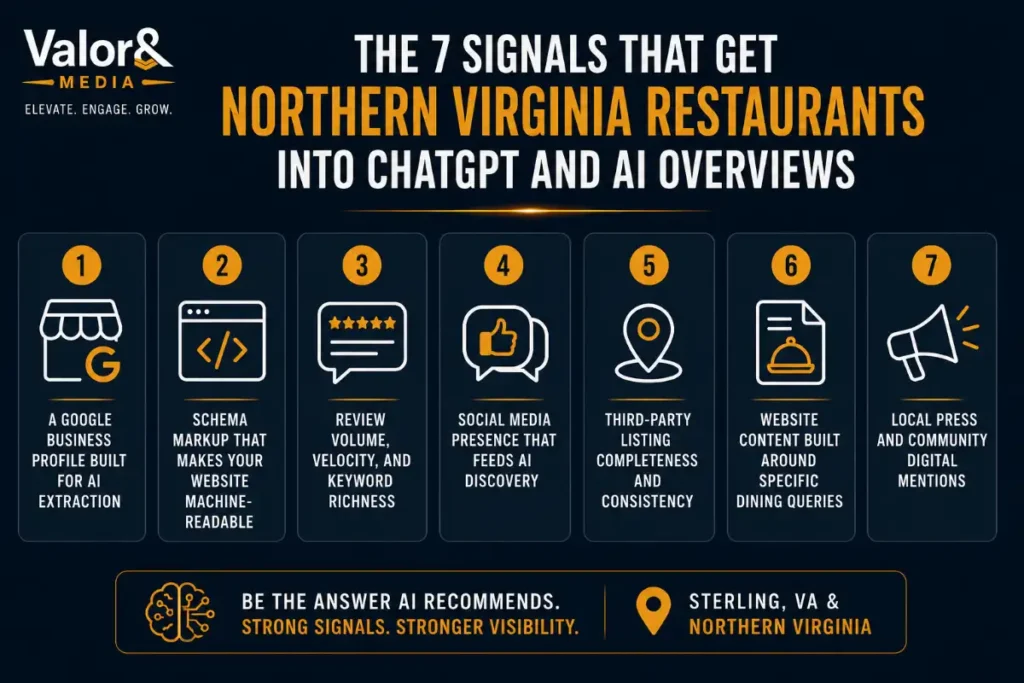
Signal 1: A Google Business Profile Built for AI Extraction
Your Google Business Profile is the single most cited source for AI restaurant recommendations. Among AI citations for restaurants, the most, at 41.6 percent, came from listings on third-party sites such as Yelp, Google Business, or DoorDash. Slightly fewer, at 39.8 percent, came from first-party websites.
For Sterling and Northern Virginia restaurants, a GBP optimized for AI search goes well beyond basic information. It requires:
Cuisine specificity in your business description: Do not write “we serve great food in a warm atmosphere.” Write “Sterling’s only authentic Peruvian ceviche bar serving Loudoun County’s freshest fish with a 40-label pisco cocktail program and a rooftop terrace.” Every specific, searchable phrase is a signal AI can match to a diner’s query.
Attributes that answer specific diner queries: Google’s attribute system allows restaurants to flag outdoor seating, live music, craft cocktails, vegan options, gluten-free menu, late night dining, private dining rooms, and dozens of other filters that AI engines use when answering specific dining queries. Every attribute you fail to activate is a filter you disappear from.
Weekly Google Posts signaling an active establishment: AI systems weight recency. A restaurant that published a Google Post last Tuesday signals more reliably than one with its last post from nine months ago. Post your weekly specials, new seasonal menu items, private event availability, and local Loudoun County dining events every single week.
Menu items listed directly in GBP: Google now allows restaurants to add individual menu items with descriptions and prices. These become extractable, structured data that AI engines reference when a diner asks “where can I get a specific dish in Northern Virginia.”
Valor& Media’s restaurant and bar digital marketing service handles complete GBP optimization and management for independent restaurants across Sterling, Ashburn, Reston, Herndon, and the greater Northern Virginia market.
Signal 2: Schema Markup That Makes Your Website Machine-Readable
Your restaurant website is either machine-readable or it is a black box to AI search engines. The difference between a restaurant that appears in ChatGPT responses and one that does not often comes down entirely to whether structured schema markup exists on the website.
The schema types every Northern Virginia restaurant website needs:
Restaurant schema: Your restaurant name, cuisine type, address, phone, opening hours, price range, and aggregate rating in a single, machine-readable JSON-LD block that every AI engine can parse in milliseconds.
Menu schema: Individual menu items with names, descriptions, and prices structured for AI extraction. When someone asks ChatGPT “does your restaurant have vegetarian options,” the answer comes from your Menu schema, not from someone hoping the AI reads your PDF menu.
LocalBusiness schema: Reinforces your geographic entity signals, service radius, and operational details that AI engines use when responding to location-based queries.
FAQPage schema: Answers to the questions diners most commonly ask about your restaurant. “Do you take reservations?” “Is there parking?” “Do you have a private dining room for events?” “What is your happy hour?” These FAQ answers in schema format are extracted directly by Google AI Overviews and ChatGPT when diners ask these questions.
If your current restaurant website does not have these schema types implemented, you are structurally excluded from AI Overview recommendations regardless of how good your food is. Valor& Media’s web design and development service implements complete restaurant schema packages as part of every hospitality website build and rebuild.
Signal 3: Review Volume, Velocity, and Keyword Richness
Higher star rating alone does not guarantee better AI search visibility. ChatGPT appears to favor restaurants with 4.5 or more stars more heavily than Google, but star rating without review volume and review specificity is not enough to earn AI recommendation.
What actually moves the AI recommendation needle for Sterling and Northern Virginia restaurants:
Volume above the AI inclusion threshold: The data suggests AI platforms have significantly higher barriers for inclusion, requiring higher minimum review counts for recommendation. A restaurant with 25 reviews competes poorly against a competitor with 180, regardless of star rating.
Review keyword density for your specialty: If you want to appear when a diner asks ChatGPT “best crab cakes in Northern Virginia,” you need a substantial number of reviews that mention crab cakes specifically. AI systems look for consistent thematic signals across reviews, not just star averages. Reviews that use specific dish names, specific ambiance descriptors, and specific occasion types such as “perfect for a date night,” “great for a work lunch,” or “ideal birthday celebration” create the thematic clusters AI engines use for specific recommendation queries.
Recency over history: A restaurant with 200 old reviews and 5 recent ones signals decline. A restaurant building 10 to 20 new reviews per month signals consistent quality and reliable current operations.
Cross-platform review distribution: ChatGPT, Gemini, and Perplexity pull review signals from Google, Yelp, TripAdvisor, OpenTable, Facebook, and Eater. A restaurant with 150 Google reviews and zero reviews anywhere else has a thinner AI signal profile than a restaurant with 80 Google reviews, 40 Yelp reviews, 30 TripAdvisor reviews, and 20 OpenTable reviews showing consistent signal across platforms.
Valor& Media’s strategy and content creation service builds systematic review generation programs for restaurants across Northern Virginia, including post-visit SMS and email automation, staff incentive frameworks, and cross-platform review distribution strategies.
Signal 4: Social Media Presence That Feeds AI Discovery
Search is now multi-channel. TikTok, Instagram, Maps, and ChatGPT are all part of the same discovery funnel. A restaurant social media activity is not separate from its AI search visibility. It is a direct input into it.
AI engines pull from indexed social content when building their understanding of what a restaurant is known for. An Instagram Reel of your open kitchen that has been shared 400 times, saved by 800 people, and captioned with “Sterling VA date night,” “Northern Virginia Italian food,” and “Loudoun County pasta” is a structured signal AI engines can extract and use.
What social media activity specifically feeds AI visibility for Sterling and Northern Virginia restaurants:
Instagram: Instagram marketing with location-tagged posts, dish-specific captions that use natural search language such as “our hand-pulled pasta in Sterling” or “Loudoun County best brunch spot,” and consistent Reels showing kitchen activity, plating, and guest experiences. Visual content showing real experience, not stock photos, is what both Gen Z diners and AI systems weight most heavily.
TikTok: TikTok campaigns built around authentic kitchen content, chef storytelling, and honest dining experiences outperform polished brand videos in both organic reach and AI signal value. 71 percent of Gen Z and 68 percent of Millennials plan to dine out more in 2026, and TikTok is the primary discovery channel for these demographics in the Northern Virginia market.
Facebook: Facebook marketing drives community engagement and generates tagged mentions that AI engines index. Event posts for weekly specials, private dining availability, and seasonal menus create structured, date-specific content AI can reference when answering queries about your restaurant.
YouTube: A YouTube marketing presence for restaurant brands, even at modest scale, creates video content that ranks for Northern Virginia dining queries and feeds the AI systems that increasingly pull from YouTube data when summarizing restaurant recommendations.
The cumulative effect of multi-platform social activity is a restaurant that appears everywhere a searcher looks, which is exactly the consistent presence AI engines interpret as trustworthy and recommendation-worthy.
Signal 5: Third-Party Listing Completeness and Consistency
Beyond Google Business Profile, AI engines pull from a network of third-party restaurant platforms. The completeness and consistency of your presence across these platforms directly affects your AI citation probability.
For Sterling and Northern Virginia independent restaurants, the critical third-party platforms are:
Yelp: Despite its reputation for controversy among restaurant owners, Yelp is one of the primary data sources for ChatGPT restaurant recommendations. A complete, photo-rich, consistently maintained Yelp profile with active owner responses to reviews is an AI visibility asset regardless of personal opinion of the platform.
TripAdvisor: Particularly important for AI citations targeting travelers visiting the Dulles corridor, government visitors to DC, and weekend tourists from Baltimore and Philadelphia discovering Northern Virginia dining.
OpenTable and Resy: Reservation platform profiles signal operational legitimacy to AI engines. A restaurant that accepts online reservations through a major platform appears more established and reliably operational than one that does not.
Eater DC and local food media: A mention in Eater DC, the Washington Post food section, Northern Virginia Magazine, or Washingtonian is worth more AI visibility than any amount of self-published content. Independent editorial coverage from trusted local publications is one of the strongest AI citation signals available. Paying for press in a respected outlet is more valuable than ever.
Nextdoor: The hyperlocal social network is increasingly indexed by AI engines for genuinely local recommendations. Sterling and Ashburn neighborhood recommendations on Nextdoor are exactly the kind of authentic local signal that makes an AI engine confident recommending a restaurant for “best neighborhood spots in Loudoun County.
Signal 6: Website Content Built Around Specific Dining Queries
A restaurant website optimized for how restaurants show up in ChatGPT and AI Overviews looks fundamentally different from a standard restaurant website. It is not just a beautiful menu and a reservation button. It is structured, indexed, AI-extractable content that answers the specific questions diners are asking AI assistants.
Every Northern Virginia restaurant website should include dedicated pages or detailed sections addressing:
Occasion-specific content: Private dining for corporate events in Sterling VA, anniversary dinner Northern Virginia, rehearsal dinner venues Loudoun County, birthday celebrations Ashburn restaurant. Each occasion type is a query category AI engines receive constantly. A restaurant with dedicated content for each occasion earns recommendation placement for each category.
Dietary requirement specificity: Vegan menu options Sterling VA restaurant, gluten-free friendly dining Northern Virginia, allergen-aware kitchen Loudoun County. These specific, query-matching phrases in your website content are pulled by AI engines when diners ask for restaurants accommodating their dietary needs.
Neighborhood and proximity content: Restaurant walking distance from One Loudoun, dining near Dulles Town Center, restaurants close to Reston Town Center, dinner near Dulles International Airport. Location proximity phrases that match how Northern Virginia diners actually phrase their AI searches.
Chef and sourcing story content: AI systems building a composite picture of your restaurant look for authentic authority signals. A detailed page about your chef background, your sourcing relationships with local Loudoun County farms, or your wine program gives AI engines rich, differentiated content that makes your restaurant specifically recommendable rather than generically listed.
Valor& Media’s SEO strategy service builds the full content architecture for restaurant websites targeting both traditional Google rankings and AI search visibility across Sterling, Northern Virginia, and the DMV.
Signal 7: Local Press and Community Digital Mentions
The final and often most powerful signal in how restaurants show up in ChatGPT and AI Overviews is earned media from credible local sources.
When Eater DC, the Washington Post, Northern Virginia Magazine, Washingtonian, or a Loudoun County food blogger publishes a review of your restaurant, that editorial content is indexed across the web and becomes primary source material for AI engines building restaurant recommendations. The influence of a single Washington Post dining review on AI citation probability for a Sterling restaurant exceeds the impact of years of self-published blog content.
Strategies for building local press coverage and community digital mentions in Northern Virginia:
Pitch story angles to DMV food media: New chef appointments, seasonal menu launches, local farm sourcing partnerships, private dining room openings, and restaurant anniversary milestones are all genuine news angles that food editors at Eater DC, Washingtonian, and the Washington Post cover regularly.
Participate in Northern Virginia dining events: Loudoun County Restaurant Week, Leesburg Food and Wine Festival, Washington DC Restaurant Week, and Tysons dining events all generate local press coverage that includes restaurant mentions indexed by AI engines.
Collaborate with Northern Virginia food creators: Food content creators in the DMV market with engaged local audiences create AI-indexable content mentioning your restaurant that builds the community signal profile AI engines look for when confirming a restaurant is genuinely loved locally.
Sponsor local community events: Community sponsorships generate local press mentions, digital program listings, and social media tags that cumulatively build the web-wide mention profile that signals to AI engines your restaurant is a genuine community institution in Sterling or Northern Virginia, not just a listing.
Test Your Restaurant AI Visibility Right Now
Before spending any budget on optimization, run this diagnostic test to understand exactly where your Northern Virginia restaurant currently stands in AI search.
Open ChatGPT, Gemini, and Perplexity separately. In each one, run queries your ideal diner would ask:
- “Best [your cuisine type] restaurant in Sterling VA”
- “Good restaurants for a date night near Dulles Airport”
- “Where to eat in Loudoun County for a special occasion”
- “Best [specific dish you are known for] in Northern Virginia”
Look for three possible patterns in the results. Your restaurant appears consistently across all three, which means your AI signals are working. Your restaurant appears in some but not all platforms, which means you have coverage gaps in specific signal categories. Your restaurant does not appear in any results, which means you have structural AI visibility issues that require systematic attention across multiple signal categories.
The most common finding for independent restaurants in Sterling and Northern Virginia is the second pattern. Present in one AI engine, invisible in others. That asymmetry reflects inconsistent entity signals across platforms and is fixable with a structured optimization program.
How Valor& Media Builds AI Visibility for Sterling and Northern Virginia Restaurants
Valor& Media is headquartered at 1334 Shepard Dr, Sterling, VA 20164, inside the Northern Virginia dining market. The full-stack digital marketing team serves independent restaurants, bars, and hospitality businesses across the DMV with an integrated approach that connects every AI visibility signal into one accountable system.
A Valor& Media restaurant AI visibility engagement covers:
Google Business Profile optimization and management, including weekly posting, menu item listing, attribute activation, and review response management for every location.
Schema markup implementation covering Restaurant, Menu, LocalBusiness, and FAQPage schema on your existing or rebuilt restaurant website.
Social media marketing across Instagram, Facebook, TikTok, and YouTube with location-tagged, query-matched content built for both human engagement and AI indexing.
Review generation and cross-platform distribution creating the review volume, velocity, and keyword richness that moves your restaurant above the AI inclusion threshold.
SEO strategy building the occasion-specific, dietary-specific, and proximity-specific content architecture that matches how Northern Virginia diners actually query AI engines.
Website design and development for restaurants that need a complete rebuild with AI-optimized schema, fast mobile load times, and structured content architecture.
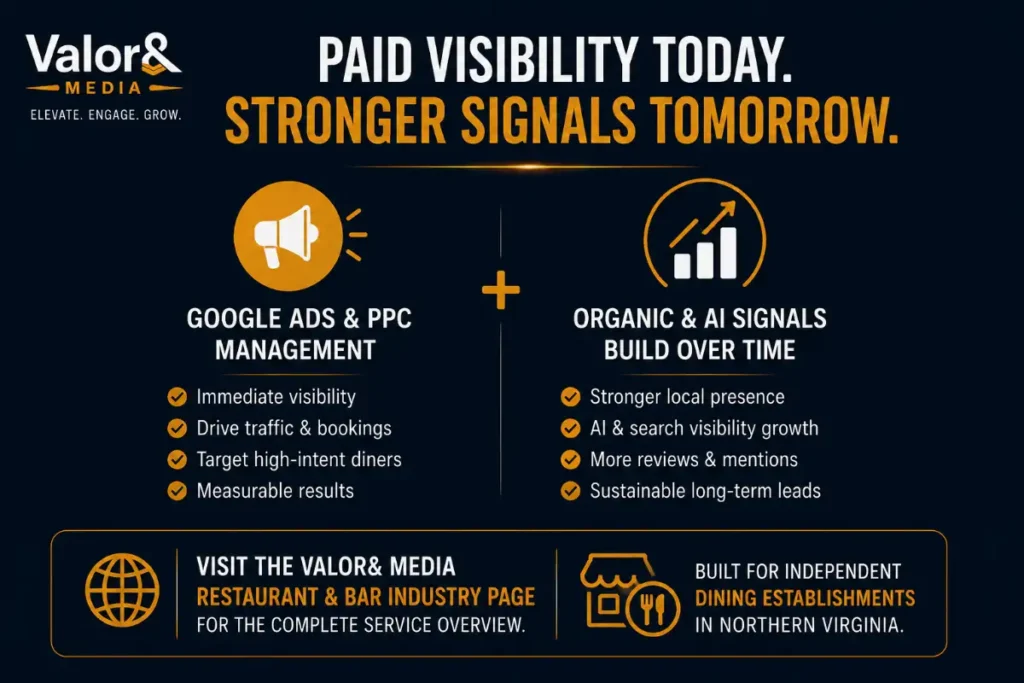
Google Ads and PPC management for restaurants that want paid visibility while organic and AI signals build.
Visit the Valor& Media restaurant and bar industry page for the complete service overview built specifically for independent dining establishments in Northern Virginia.
Frequently Asked Questions About Restaurant AI Search Visibility
Why does my restaurant appear on Google Maps but not in ChatGPT results?
Google Maps uses proximity, star rating, and review volume as its primary ranking signals. ChatGPT, Gemini, and Perplexity use a different and more complex signal set including review keyword consistency, third-party listing completeness, website schema markup, and web-wide mention patterns. A restaurant can rank well on Google Maps and remain invisible in AI search if the AI-specific signals are missing.
How many reviews does a Sterling restaurant need to appear in ChatGPT recommendations?
The data suggests AI platforms require significantly higher minimum review counts than Google for inclusion in recommendations. For competitive Northern Virginia dining markets, restaurants below 75 to 100 recent reviews face significant barriers to consistent AI recommendation. The threshold is also query-dependent: a restaurant may appear for a broad query with fewer reviews but disappear for specific cuisine or occasion queries without the review volume and keyword richness to match.
Does paying for ChatGPT advertising guarantee restaurant visibility?
No. OpenAI launched ChatGPT advertising in February 2026 with a minimum ad buy of $200,000, which places it completely out of reach for independent restaurants. Organic AI search visibility through the seven signals described in this guide is the only accessible path to consistent AI recommendation for independent restaurants in Sterling and Northern Virginia.
How long does it take to build AI search visibility for a Northern Virginia restaurant?
Initial AI citation improvements are measurable within 60 to 90 days of implementing GBP optimization, schema markup, and an active review generation program. Consistent multi-platform AI recommendation placement typically builds over 4 to 6 months of sustained effort across all seven signal categories.
Can Valor& Media help my restaurant show up in ChatGPT and AI Overviews?
Yes. Valor& Media builds complete AI visibility strategies for independent restaurants across Sterling, Northern Virginia, and the DMV. Book a free restaurant AI visibility audit and get a diagnostic of exactly where your restaurant currently stands in AI search and the specific actions that will move the needle fastest for your location.
What is the most important first step for a Sterling restaurant that is invisible in AI search?
Start with your Google Business Profile. Complete every field, activate every relevant attribute, add your full menu with item-level descriptions, upload a minimum of 20 to 25 current photos, and implement a systematic process for requesting and responding to reviews. The GBP is the most cited source in AI restaurant recommendations and the highest-ROI starting point for restaurants with limited optimization budgets.
Your Tables Are Being Filled by the Restaurants That Got There First
How restaurants show up in ChatGPT and AI Overviews is not a future trend to watch. It is a current competitive reality reshaping which tables in Sterling and Northern Virginia get filled every weekend night.
83 percent of restaurants are already invisible in AI search. The 17 percent that are visible are winning a disproportionate share of reservations from an increasingly AI-dependent dining public. That 17 percent is not full yet. But it is filling faster than most restaurant owners realize.
The structural signals that get a restaurant into AI recommendations, consistent entity data, rich schema markup, keyword-specific review velocity, active multi-platform social presence, and earned local press coverage, take time to build. Every week that passes without implementing them is a week the competition builds their AI signal profile while yours stays static.
Valor& Media builds AI visibility for independent restaurants in Sterling and across Northern Virginia. The full-stack team connects every signal that matters into one integrated system designed to get your restaurant into the AI recommendation shortlist and keep it there. See us on Instagram & LinkedIn.
Three ways to start today:
- Book a free restaurant AI visibility audit and find out exactly where you stand in ChatGPT, Gemini, and AI Overviews right now
- Email the team: hello@valorandmedia.com
- Call: (202) 400-0428
Office: 1334 Shepard Dr, Sterling, VA 20164, right in the heart of the Northern Virginia dining market.
The next diner asking ChatGPT where to eat in Sterling tonight should find your restaurant in the answer. Let Valor& Media make sure they do.