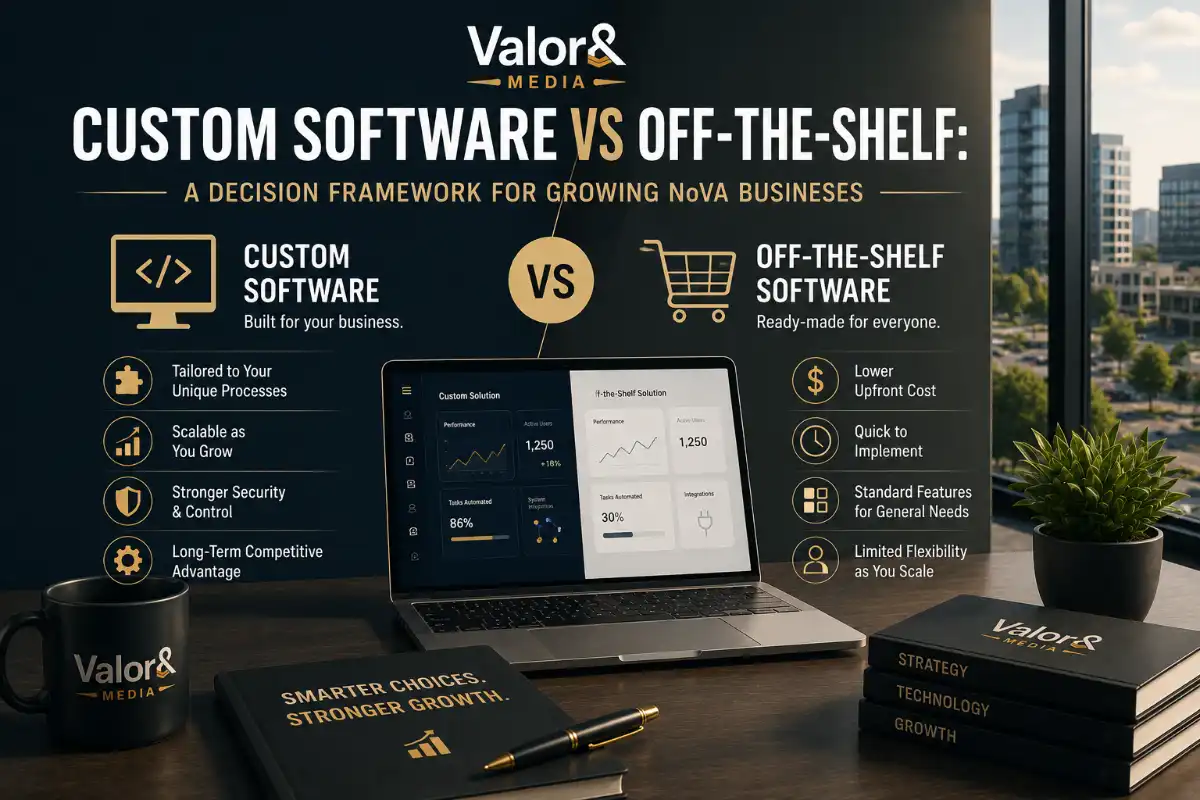
Custom software vs off-the-shelf is the most expensive decision most Northern Virginia business owners make without a framework. Get it right and you compound an advantage for a decade. Get it wrong and you spend the next three years paying consultants to force a tool to behave like something you should have built in the first place.
Here is what nobody tells you. The decision is almost never about the software. It is about which parts of your business are genuinely yours and which parts are commodity. Confuse the two and you either overbuild something a $99 subscription already solved, or you cripple your best process to fit somebody else’s template.
This guide gives you the framework. Real numbers, a scorecard you can complete in ten minutes, the Northern Virginia specifics no national blog covers, and the exact failure patterns Valor& Media sees across the Dulles Corridor. Read it once and you will never make this call on gut feel again.
Custom Software vs Off-the-Shelf: The 30 Second Answer
Buy off-the-shelf when the job is a commodity. Accounting, payroll, email, ticketing, standard CRM. Millions of companies do it the same way and being different adds nothing.
Build custom when the workflow is your competitive advantage. If the way you operate is the reason customers choose you, do not hand that process to a vendor who designed it for the average of ten thousand other businesses.
Most growing companies land in the middle. That is not indecision. That is the correct answer, as long as you drew the line on purpose instead of by accident.
Now let us make it precise.
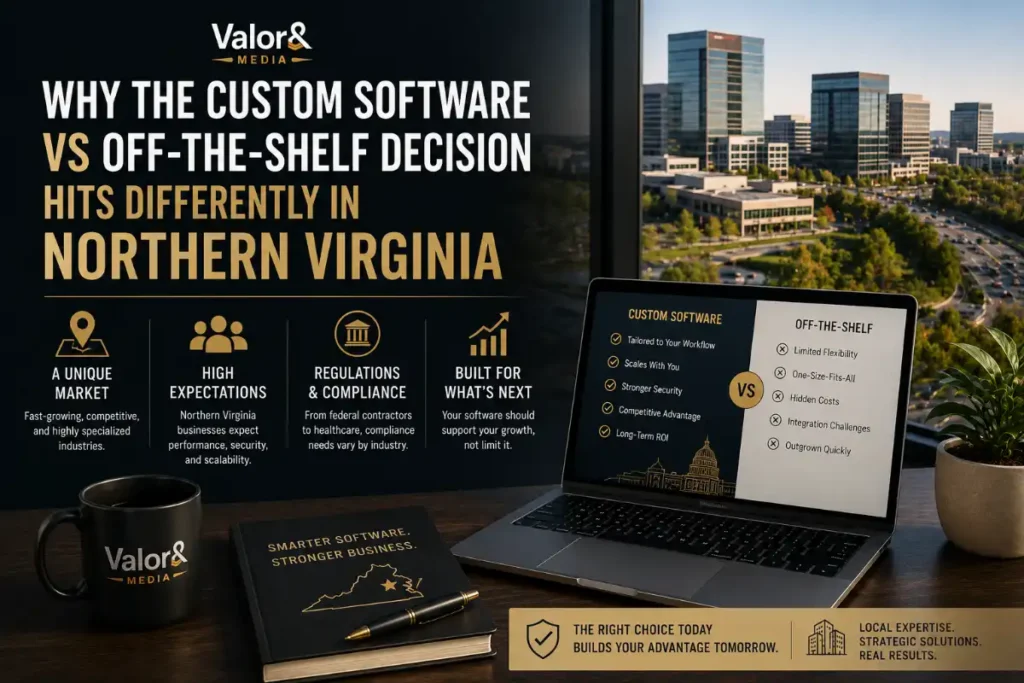
Why the Custom Software vs Off-the-Shelf Decision Hits Differently in Northern Virginia
Every national article treats this as a universal question. In NoVA it is not. Three regional realities change the math.
Compliance Is Not Optional Here
Northern Virginia runs on government work. If you touch federal contracts, subcontract to a prime, or serve agencies in any capacity, your software choices carry regulatory weight that a company in Boise never thinks about.
CMMC 2.0 is now phasing into defense contracts, and Level 2 requires implementation of the 110 security controls in NIST SP 800-171 across 14 control families, verified by a third party assessment rather than a self-attestation. If you handle Controlled Unclassified Information, your systems, your data flows, and your access controls all fall inside scope. Layer on Section 508 accessibility for public facing systems and the Virginia Consumer Data Protection Act for personal data, and the picture changes fast.
Why does this decide custom software vs off-the-shelf? Because a SaaS vendor decides your data residency, your logging, your encryption posture, and your audit trail. If their roadmap does not match your obligation, you have no lever to pull. With custom software, compliance is an architectural decision you control. For contractors weighing this, the CMMC requirements breakdown from CyberSheath is a useful primer before you commit to any platform.
Talent Is Expensive and Scarce
The Dulles Corridor competes for engineers against Amazon Web Services, Booz Allen Hamilton, Leidos, and thousands of contractors. Hiring an internal team to build and maintain a platform is dramatically more expensive here than the national averages every generic blog quotes.
That reality pushes many NoVA businesses toward a partner model rather than an in-house build. You get the custom fit without carrying the payroll.
Your Buyers Are Enterprise Grade
Selling into agencies, primes, hospitals, or regional enterprises means procurement reviews, security questionnaires, and integration requirements. Off-the-shelf tools frequently fail those reviews on a single missing capability. Custom systems can be designed to pass them.
What Off-the-Shelf Software Actually Gives You
Let us be fair to the option most businesses should choose most of the time.
- Speed. Live in days, not months. Basic implementations are operational almost immediately.
- Predictable cost. A subscription line item your CFO can forecast.
- Battle tested defaults. A good vendor has already solved edge cases you have not hit yet.
- Shared maintenance. Their engineers handle uptime, patching, and security updates.
- A support team. Someone else answers the phone at 2 a.m.
Buying is not the lazy choice. Buying is the disciplined choice for anything that does not differentiate you.
What Custom Software Actually Gives You
- Exact process fit. Your workflow, your data model, your rules. No workarounds, no shadow spreadsheets.
- Ownership. You own the code, the data, and the roadmap. Nobody deprecates a feature you depend on.
- Integration freedom. Connect the legacy system, the field devices, the government portal, the accounting stack. Whatever you actually run.
- Compliance control. Build to your regulatory requirement rather than hoping a vendor gets there.
- No per seat tax on growth. Add a hundred users without a pricing conversation.
- A defensible moat. Competitors can buy the same SaaS you can. They cannot buy your system.
The custom software vs off-the-shelf tradeoff is not quality. It is fit versus speed, and ownership versus convenience.
The 5 Year Cost Comparison Nobody Shows You
Year one comparisons are marketing. Year five comparisons are reality. Here is an honest, illustrative model for a growing NoVA business running an operational system across roughly 40 users.
| Cost Line | Off-the-Shelf | Custom Build |
|---|---|---|
| Year 1 build or implementation | $15,000 to $40,000 setup, migration, training | $60,000 to $180,000 for a focused MVP |
| Annual license or subscription | $30,000 to $90,000, rising with seats | $0 |
| Annual hosting and infrastructure | Included | $4,000 to $15,000 |
| Annual maintenance and enhancement | Included | $12,000 to $36,000 |
| Customization and integration work | $10,000 to $50,000 in consultants and connectors | Included in scope |
| Workaround labor cost | The hidden killer. Manual steps, double entry, exports | Near zero when built correctly |
| Exit cost | Data extraction, retraining, re-implementation | You already own everything |
Two honest notes. First, these are planning ranges, not quotes, and scope drives everything. Second, custom rarely wins on a two year horizon. It frequently wins on a five year horizon once subscriptions, seat growth, connector fees, and the cost of imperfect fit compound.
That last line item is the one finance teams miss. If four employees each waste 45 minutes a day working around a tool, that is roughly 750 hours a year of pure friction. Price that at a loaded NoVA salary and the annual cost lands in the tens of thousands. Silently. Forever.
The Valor& Media Build or Buy Scorecard
Score each factor from 1 to 5, where 1 strongly favors buying and 5 strongly favors building. Multiply by the weight and total it up.
| Factor | Weight | What to Ask Yourself |
|---|---|---|
| Strategic differentiation | 30% | Is this process the reason customers pick us? |
| Fit gap | 20% | Does the best available product cover 80% of requirements without ugly workarounds? |
| Compliance and security | 15% | Do CMMC, NIST, Section 508, HIPAA, or VCDPA obligations apply? |
| Integration complexity | 15% | How many systems must talk to each other, including legacy ones? |
| Growth and seat economics | 10% | What does this cost at 3x our current headcount? |
| Time pressure | 10% | Do we need this working in weeks or can we invest months? |
Reading your score:
- Under 2.5: Buy. Configure well and move on. Do not romanticize building.
- 2.5 to 3.4: Go hybrid. Buy the commodity layer, build the differentiated layer, integrate them properly.
- 3.5 and above: Build. The fit gap, the compliance exposure, or the strategic value justifies it.
Weight the factors to your reality. A healthcare practice in Reston should weight compliance far heavier than an e-commerce brand in Ashburn weights it.
Seven Signs You Have Outgrown Off-the-Shelf
If four or more of these describe your operation, the custom software vs off-the-shelf question has already answered itself.
- Your team maintains spreadsheets to fix what the software cannot do.
- You pay for three overlapping tools because none does the whole job.
- Onboarding a new hire takes weeks because the workflow is held together by tribal knowledge.
- Your subscription bill grows faster than your revenue.
- You have been told “that is on our roadmap” for more than a year.
- Two systems hold the same customer data and disagree about it.
- A compliance or procurement review flagged a gap your vendor will not close.
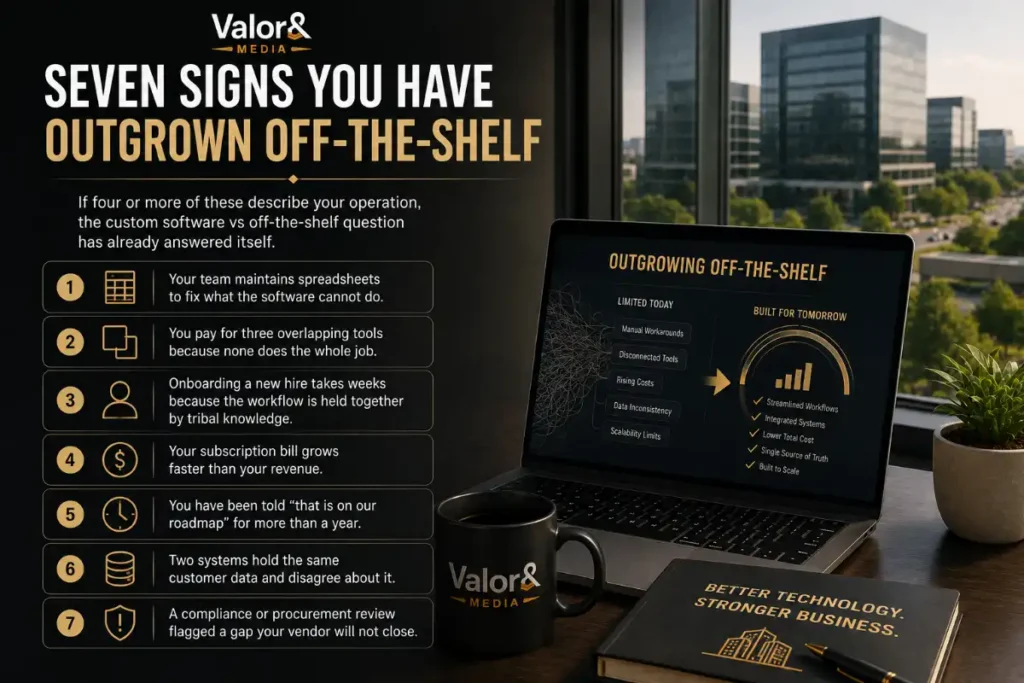
Every one of those is a tax. Individually annoying. Collectively, they are why growth stalls at a certain revenue ceiling.
When Off-the-Shelf Is Still the Smarter Call
Good advisors talk you out of spending money. Buy, do not build, when:
- The function is a solved commodity. Payroll, accounting, email, e-signature, standard helpdesk.
- You need it working in three weeks.
- Your process is not yet stable. Never build software around a workflow you are still inventing.
- The budget cannot absorb both the build and the ongoing enhancement. A half funded custom system is worse than a well configured SaaS tool.
- Regulatory requirements are standard and the vendor already carries the certifications.
Building the wrong thing is more expensive than buying the imperfect thing. Every time.
The Hybrid Model: Where Most Growing NoVA Businesses Should Land
The smartest companies in the region stopped treating custom software vs off-the-shelf as binary years ago.
They buy the commodity layer. Accounting, CRM, communications, HR. Then they build the thin layer of genuinely proprietary logic on top, and they invest properly in the integration between them.
In practice that looks like a custom client portal that pulls from your existing CRM. A custom quoting or estimating engine that writes back into your accounting system. A compliance dashboard that aggregates what four vendor tools report separately. A field operations app that syncs to the platform your back office already lives in.
You get speed where speed is cheap and differentiation where differentiation pays. That is the answer for most companies between $2M and $50M in revenue, which describes a large share of the businesses along the Route 7 and Route 28 corridors.
Three NoVA Scenarios We See Constantly
The government subcontractor in Chantilly. Off-the-shelf project management could not produce the audit trail their prime demanded. A custom compliance and reporting layer, built over an existing stack, kept them eligible to bid. Verdict: build the compliance layer, buy everything else.
The multi-location home services company in Ashburn. Six locations, four disconnected tools, scheduling chaos. Their differentiator was dispatch logic no vendor supported. Verdict: buy the CRM, build the dispatch engine, integrate tightly.
The specialty clinic in Reston. Regulated, standardized workflows, tight budget. Verdict: buy the certified platform, configure it well, and spend the savings on patient acquisition instead. Building would have burned capital for zero advantage.
Same framework. Three different answers. That is how you know the framework works.
Custom Software vs Off-the-Shelf Mistakes That Cost NoVA Businesses Six Figures
- Deciding on price alone. Cheapest year one is frequently most expensive year five.
- Building before the process is stable. Codify chaos and you get expensive, permanent chaos.
- Skipping discovery. Every failed build traces back to requirements nobody validated with the people doing the work.
- Ignoring the exit. Ask any vendor what happens to your data when you leave. The hesitation tells you everything.
- Choosing a developer who cannot explain tradeoffs in plain English. If they will not tell you when not to build, they are selling, not advising.
- Forgetting adoption. Software nobody uses has an ROI of zero regardless of how well it was engineered.
How Valor& Media Approaches Custom Software in Sterling, VA
Valor& Media operates from 1334 Shepard Dr, Sterling, VA 20164, in the middle of the Dulles Corridor. Not offshore. Not a reseller. A local team with 15+ years of leadership across strategy, technology, and growth.
We architect for what you become, not just what you need this quarter. Microservices, serverless functions, containerized applications, Node.js APIs, .NET Core services, Python and Django backends. We select the pattern that fits your scale, so you do not outgrow your own code eighteen months after launch.
More importantly, we will tell you when not to build. If the honest answer is buy and configure, that is the answer you get.
Explore how the pieces connect:
- Custom software development services, architecture, integrations, and enterprise systems
- Digital marketing in Sterling VA, the complete local growth guide
- Top digital marketing and SEO agency in Virginia, how to choose a partner without regret
- Google Ads management to drive demand into whatever you build
- Instagram marketing and YouTube marketing to build the brand behind the platform
- See everything Valor& Media builds
Service areas: Sterling, Ashburn, Herndon, Reston, Leesburg, Chantilly, Centreville, Great Falls, Vienna, Tysons, Fairfax, Arlington, Alexandria, and the wider DMV.
Frequently Asked Questions
What is the difference between custom software and off-the-shelf software? Off-the-shelf software is a prebuilt product sold to many companies, usually by subscription. Custom software is built specifically around your workflows, data model, and business rules, and you own it.
Is custom software cheaper than off-the-shelf in the long run? Sometimes. Custom typically costs more in years one and two and can cost less by year four or five once subscription growth, seat pricing, connector fees, and workaround labor are counted. The deciding factor is usually fit, not price.
How long does a custom software build take? A focused first version commonly takes three to five months with an experienced partner. A full platform with complex integrations usually runs six to twelve months. Anyone quoting a full enterprise system in six weeks is describing a prototype.
Should a small business in Northern Virginia build custom software? Only where the software is a competitive advantage or a compliance requirement. For everything else, buy well and reinvest the savings into growth.
What if I already bought the wrong platform? That is recoverable and common. The usual fix is not a rip and replace. It is building the missing layer around what you already own so the investment keeps working while the gap closes.
Make the Call With Data, Not Pressure
You do not need a hunch. You need thirty minutes and someone who profits either way.
Valor& Media will run a free build or buy assessment on your situation, map your workflows against the scorecard above, model your realistic five year cost for both paths, and tell you plainly which one wins. If the answer is buy, we will say buy and name the tools. See us on Instagram & LinkedIn.
Call (202) 400-0428. Email hello@valorandmedia.com. Or book your free assessment now.
Stop paying the workaround tax. Start owning the advantage.